The Aeon Herald / HISTORICAL EDITION
Griffith Observatory Opens a Public Window on the Sky
The city has opened a new public institution on its hillside, placing a telescope and an artificial sky within reach of the ordinary visitor. Griffith Observatory was dedicated Tuesday, May 14, and admitted the public the following day. The undertaking carries into operation the astronomical provisions of Griffith J. Griffith’s bequest.

Philip Fox, left, and William F. Meyer beside Griffith Observatory’s Zeiss refracting telescope on May 6, 1935. Photograph: Los Angeles Times Photographic Archive / UCLA Library Special Collections. Copyright The Regents of the University of California. CC BY 4.0. Image source · CC BY 4.0. Web-sized reproduction; no content alteration. Full negative border retained where present.
LOS ANGELES, May 19.—The city has opened a new public institution on its hillside, placing a telescope and an artificial sky within reach of the ordinary visitor. Griffith Observatory was dedicated Tuesday, May 14, and admitted the public the following day. The undertaking carries into operation the astronomical provisions of Griffith J. Griffith’s bequest.
The distinction between a research station and this municipal observatory is worth making. Here the visitor is the intended beneficiary. A person need not belong to a scientific society, possess a private instrument, or undertake a mountain expedition to receive an introduction to the heavens. The building brings astronomical instruction into the city’s park system.
Its establishment has been a long business. Griffith offered funds for a public observatory in 1912; his will supplied the means after his death in 1919. Ground was broken June 20, 1933. Ownership has now passed from the trust to the city, whose Department of Parks assumes the responsibility of operating the institution.
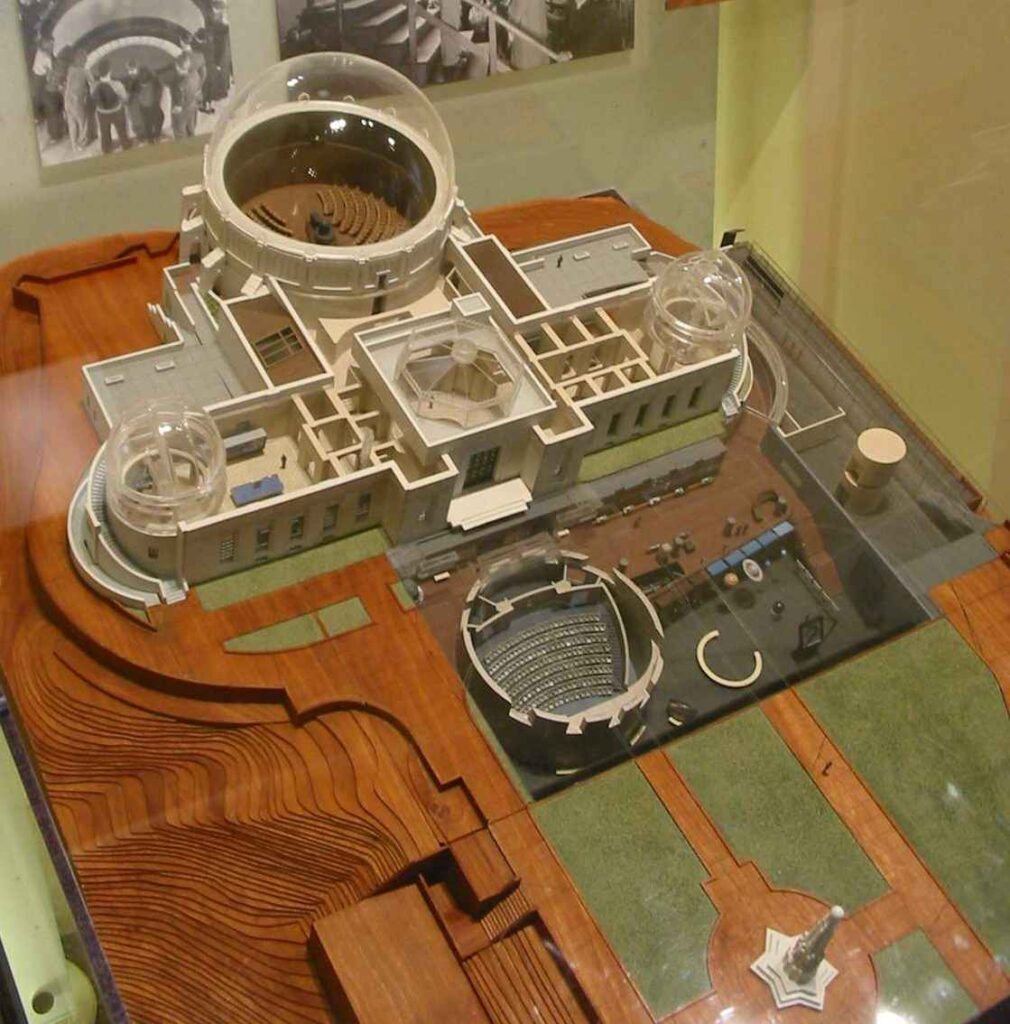
A Zeiss refracting telescope of twelve inches aperture provides the principal instrument for public observation. The planetarium supplies another manner of looking upward: a projected representation of the stars, available without waiting upon a perfectly clear night. Together they permit instruction by demonstration, rather than requiring the visitor to take every celestial arrangement upon a lecturer’s word.
The great pendulum and the solar apparatus in the Hall of Science extend that purpose. The exhibits concern the physical world as well as distant objects. A large model of part of the Moon brings another subject down to a scale that can be examined indoors.
The structure itself bears the mark of recent California experience. Following the Long Beach earthquake, the architects strengthened the proposed concrete construction. The Astronomers Monument, dedicated last November, adds a public work of sculpture to the scientific establishment.
Los Angeles has often measured its progress by the acreage it develops and the distances it can cover. This addition offers another measure: the opportunity it gives a citizen to examine something beyond his own street. The machinery is costly and the subjects immense, but the intended first step is a modest one—a visitor looking, asking, and learning.
Sources & further reading
- Historical Timeline— Griffith Observatory, City of Los Angeles; Undated institutional history; accessed November 9, 2026.
- A History of Griffith Observatory, 1896–2002— Griffith Observatory, City of Los Angeles; Undated institutional history; accessed November 9, 2026.
Related Herald reporting
- Apollo Training Gives Griffith’s Artificial Sky a Practical Task — Donald Price, 1967-12-31.
- Griffith Observatory Reopens With More Room Beneath the Hill — Eric Bennett, 2006-11-05.