The Aeon Herald / HISTORICAL EDITION
Explorer Reaches Orbit; United States Launches Satellite
The Army's Jupiter-C development carries an American scientific package into space from Cape Canaveral.
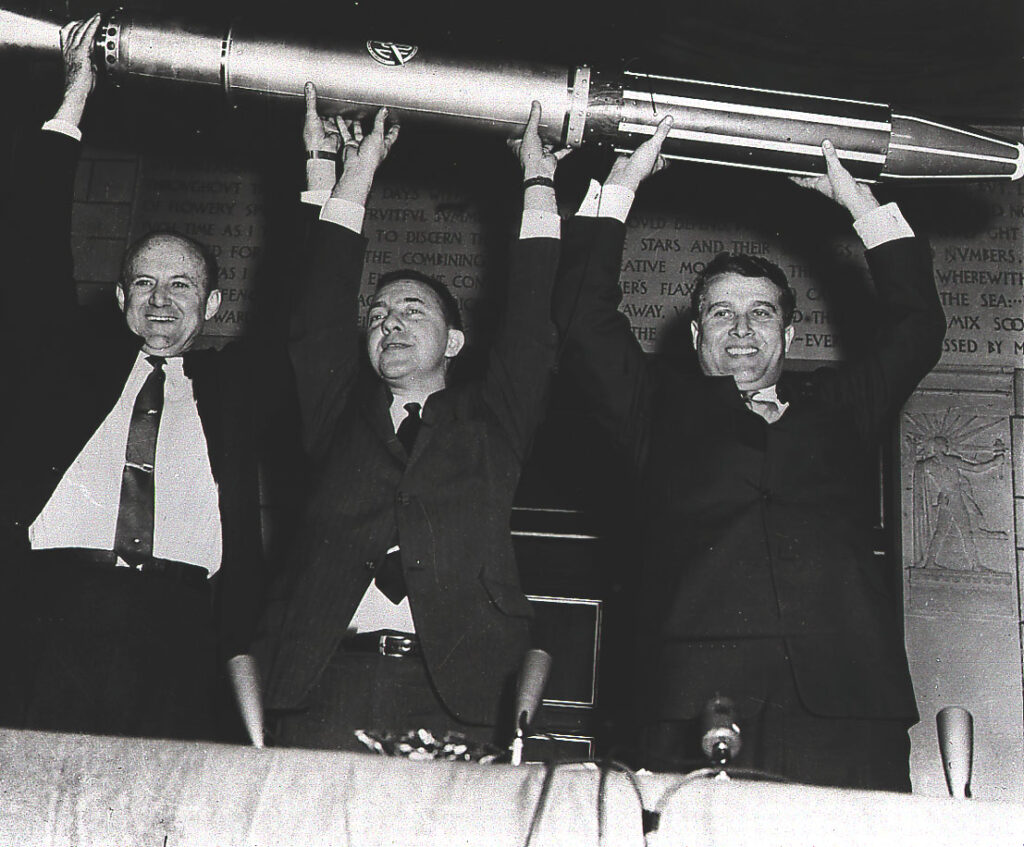
William Pickering, left, James Van Allen and Wernher von Braun display a full-size Explorer 1 model at the Washington press conference on February 1, 1958. Courtesy NASA/JPL-Caltech. Image source · Reuse terms. No content alteration; original NASA-supplied photograph.
CAPE CANAVERAL, Fla., Feb. 1.—The United States has placed its first satellite in orbit. Explorer rose from the Cape late last night aboard a Juno I rocket, giving American tracking stations a new object to follow and the country's space programme a success after months of public disappointment.
The satellite carries scientific instruments, including equipment for measuring cosmic rays. Its development joins the Army's rocket team with the Jet Propulsion Laboratory and university investigators. William Pickering, James Van Allen and Wernher von Braun are among the principal figures associated with the undertaking.
The launch follows the Soviet Union's two satellites of last year. It does not erase those achievements, but it gives the United States an operating scientific station beyond the atmosphere and a basis upon which to build further work.
Investigators will collect and analyze the instruments’ measurements. Explorer is now reporting from orbit, adding a scientific assignment to the success of the launch.
Sources & further reading
- Story of Explorer 1 — Brian C. Odom / NASA, 2018-01-19.
- Explorer 1 — NASA Science.
- Explorer1.jpg: file description — NASA / Wikimedia Commons.
Related Herald reporting
- Soviet Satellite Circles Earth; Radio Signal Heard — Paul Norton, 1957-10-05.
- Television Satellite Sends Pictures of Earth’s Clouds — Donald Price, 1960-04-02.
- First Space Station Module Reaches Orbit — Adrian Mercer, 1998-11-21.