

The Aeon Herald / HISTORICAL EDITION
Santa Ana Saucer Photographs Divide Investigators
Rex Heflin’s August photographs have brought a public disagreement between Air Force analysts and civilian investigators, with the pictures’ scale still central to the dispute.
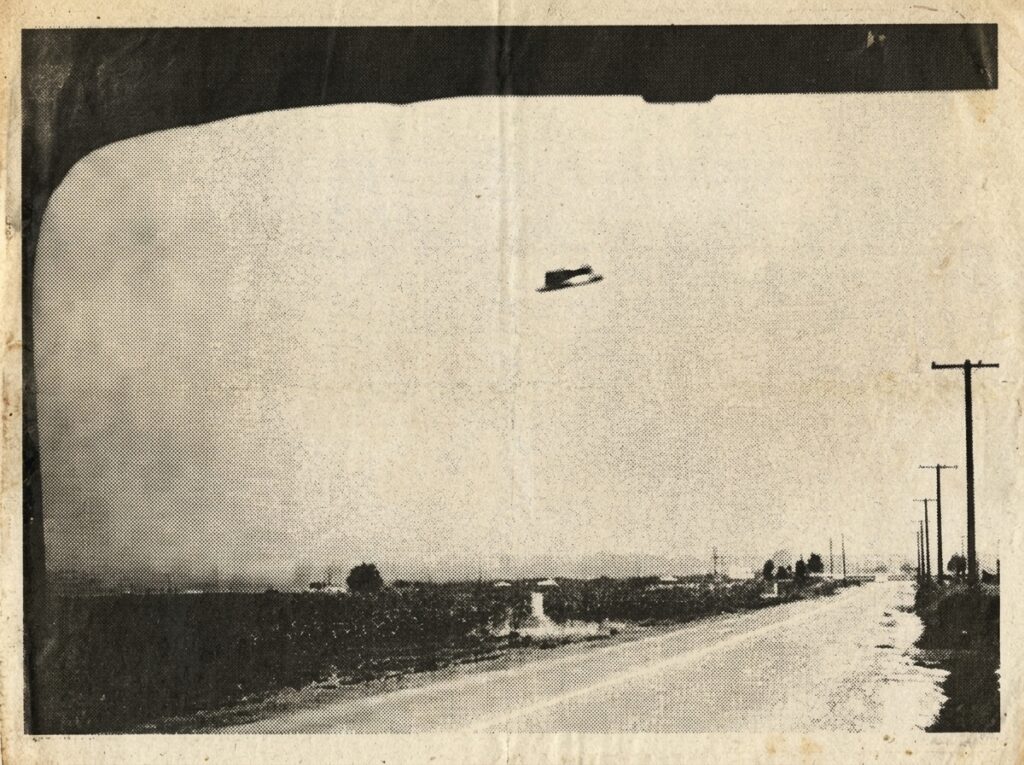
SANTA ANA, Nov. 7.— Photographs taken by an Orange County traffic investigator have produced a public disagreement between the Air Force and civilian flying-saucer investigators. The dispute concerns the distance and size of the disc-shaped object shown in three pictures.
Rex E. Heflin says he took the photographs August 3 while working on Myford Road near the Santa Ana Freeway. He used a Polaroid camera of the kind carried for recording road conditions. The first exposure was through his vehicle’s windshield and the next two through the right window.
The Santa Ana Register published an account and a photograph September 20. On October 27, Maj. Hector Quintanilla of Project Blue Book told the newspaper that the Air Force regarded the pictures as a photographic hoax. The military analysis favored a small object close to the camera rather than the large, distant object the witness described.
Ralph Rankow, a photographic adviser to the National Investigations Committee on Aerial Phenomena, disputed that judgment. A November 1 committee statement defended the witness and invited independent examination of the photographs.
A photograph can record an outline without furnishing its scale. An object nearby and one much farther away can occupy a similar portion of a print. Deciding between those possibilities requires more than making an enlargement.
The useful questions concern the camera position, foreground features and earliest available prints. Heflin’s description, the military interpretation and the civilian objection should remain distinct until evidence resolves them. Neither the witness’s confidence nor an institution’s announcement can substitute for showing how a conclusion follows from the pictures.
Sources & further reading
- Traffic Investigator Photographs — Case 52 — William K. Hartmann, University of Colorado UFO study; original report reproduced by Project 1947, 1969.
- August in O.C. History, Clerk-Recorder Newsletter — Orange County Clerk-Recorder Department, 2016-08.
Related Herald reporting
- City Awaits Explanation After Night Barrage — William Keane, 1942-02-26.
- Topanga’s Night Lights Become a Local Record of Unanswered Reports — Kevin Wallace, 1999-07-30.
- Pentagon Release Reopens Questions About 2004 Nimitz Encounter — Jeffrey Brooks, 2020-04-28.