

The Aeon Herald / HISTORICAL EDITION
Astronomers Reveal First Image of a Black Hole’s Shadow
A worldwide telescope network resolves the bright ring around the centre of galaxy M87.
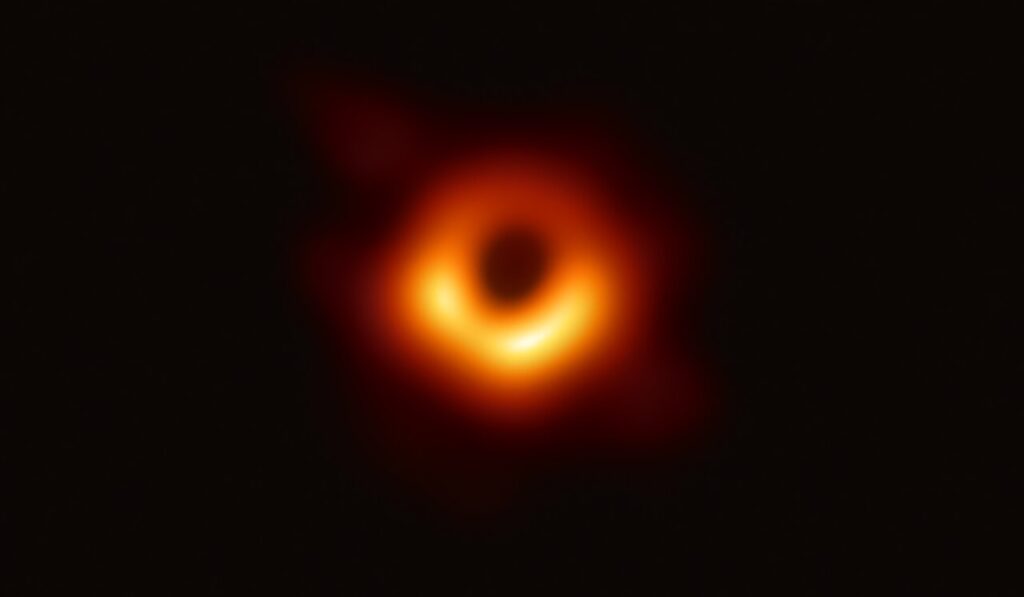
WASHINGTON, April 11—Astronomers have released the first image showing the shadow of a black hole, using observations combined from radio telescopes around the world. The Event Horizon Telescope result depicts a bright, uneven ring around a dark central region in the galaxy M87.
The picture does not show light emerging from inside the black hole. It records emission from material around it, altered by strong gravity, with the central darkness associated with light captured by the hole. That distinction is essential to understanding what has been measured.
The network used a technique that combines widely separated observatories into an instrument with the resolving power of an Earth-sized array. The final image required extensive calibration, reconstruction and checks against alternative processing methods. It is an observation built from data, rather than an artist's impression.
The result allows a direct comparison between a prediction of general relativity and the appearance of an extreme astronomical object. It also establishes a method for further observations. The ring is a dramatic picture; the ability to measure how such a system behaves is the larger scientific gain.
Sources & further reading
- Astronomers Capture First Image of a Black Hole — Event Horizon Telescope Collaboration, 2019-04-10.
- First Image of a Black Hole: ESO eso1907a — EHT Collaboration / European Southern Observatory, 2019-04-10.
- M87 image file description and derivative history — EHT Collaboration / ESO.
Related Herald reporting
- Gravitational Waves Detected From Colliding Black Holes — Sarah Nguyen, 2016-02-12.