

The Aeon Herald / HISTORICAL EDITION
Pentagon Release Reopens Questions About 2004 Nimitz Encounter
An officially released Navy recording gives the public a clearer provenance for a famous image from the Pacific. It does not settle the object’s identity, or turn a later camera recording into footage of every maneuver described by witnesses.
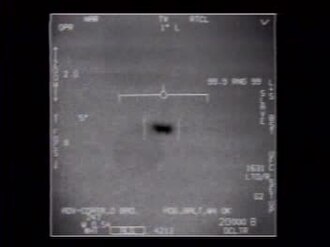
SAN DIEGO — The Pentagon has officially released three Navy videos of unidentified aerial phenomena, including a recording associated with a November 2004 encounter over Pacific waters southwest of San Diego. The decision gives a military provenance to images that have circulated for years, while leaving the identity of the objects unresolved.
The Defense Department said Monday that one video was taken in November 2004 and two in January 2015. Earlier versions had circulated publicly without authorization. Officials said a review found that releasing the material would not disclose sensitive capabilities or interfere with investigations. The observed phenomena remain unidentified, the department said.
The oldest recording is associated with the USS Nimitz carrier group and the guided-missile cruiser Princeton. On November 14, 2004, two F/A-18F aircraft were diverted from a training exercise toward an unusual contact over the ocean. The location was roughly 100 miles southwest of San Diego, in waters familiar to Navy crews preparing for deployment.
The pilots were not the only people who later described something strange. Kevin Day, a senior radar operator aboard the Princeton, told HISTORY in an account published last year that unusual contacts had appeared on the ship’s radar over several days. He described objects at unusually high altitude and sudden changes in their apparent elevation. These remain descriptions given by a participant; the released video does not supply the public with the underlying radar record.
Retired Navy commander David Fravor described the interception in a 2017 interview with ABC News. Looking down, he said, he saw disturbed water and a small white object moving nearby. He compared the elongated object to a breath mint, the description that has become the encounter’s shorthand. It moved back and forth without the visible disturbance he expected from a helicopter or jet.
Fravor said he descended toward it and that it began to match the aircraft’s movement. As he turned across its course, he recalled, it accelerated past his altitude and disappeared. When the aviators looked back toward the water, he said, the disturbance had gone as well. A controller subsequently reported a similar contact at the aircraft’s assigned holding point. Fravor’s account gives the episode its most remarkable movements, but those recollections should not be confused with measurements furnished by the released camera clip.
The recording came from a later flight. In a December interview with New York magazine’s Intelligencer, pilot Chad Underwood described concentrating on his instruments and making the infrared recording. He said he had not made the same naked-eye observation Fravor described. Two different flights therefore provide different parts of the case: one man’s visual encounter and another’s sensor record.
Monday’s release also includes two videos from January 2015. They should not be treated as additional views of the same afternoon off San Diego. Grouping the files in a single announcement brings them under the same official description, but it does not establish that every image has the same explanation.
The Nimitz episode gained a much wider audience in 2017, when news reports brought the witnesses’ accounts and the camera footage to national attention. By then the encounter was already more than a decade old. Public discussion has since moved between the pilots’ experience, questions about the images and speculation about who might possess an aircraft with the reported capabilities.
One change on Monday is documentary rather than visual: viewers can now consult an authorized military release instead of arguing only about copies passed around outside official channels. The Pentagon said it wanted to clear up misconceptions about whether the circulating footage was real. It did not accompany the release with an identification of the objects or a finding that they came from beyond Earth.
The distinction leaves a useful question in place. The aviators and shipboard personnel describe an interruption to a training exercise. What they believed they detected, what the camera recorded and what can now be established from the public material are related matters, but they are not interchangeable.
For San Diego, the unresolved story begins in the working waters beyond the coast, with aircraft in training and a cruiser watching the surrounding airspace. More than fifteen years later, the images have an official place in the public record. They have not yet acquired an official explanation.
Sources & further reading
- Statement by the Department of Defense on the Release of Historical Navy Videos— U.S. Department of Defense; April 27, 2020.
- Navy pilot recalls encounter with UFO: I think it was not from this world— Kelly McCarthy, ABC News; interview with David Fravor; December 18, 2017.
- Navy Pilot Who Filmed the Tic Tac UFO Speaks— Matthew Phelan, Intelligencer; interview with Chad Underwood; December 19, 2019.
- When Top Gun Pilots Tangled with a Baffling Tic-Tac-Shaped UFO— Greg Daugherty, HISTORY; interviews with Navy participants; May 16, 2019; current page updated May 28, 2025.
- NAVAIR FOIA document library— Naval Air Systems Command; April 27, 2020 release location; current library accessed November 9, 2026.
Related Herald reporting
- Topanga’s Night Lights Become a Local Record of Unanswered Reports — Kevin Wallace, 1999-07-30.
- Santa Ana Saucer Photographs Divide Investigators — Paul Norton, 1965-11-07.
- City Awaits Explanation After Night Barrage — William Keane, 1942-02-26.