

The Aeon Herald / HISTORICAL EDITION
Rubin Observatory’s First Images Open a New Survey Era
A giant camera in Chile demonstrates its ability to record broad, detailed views of a changing sky.
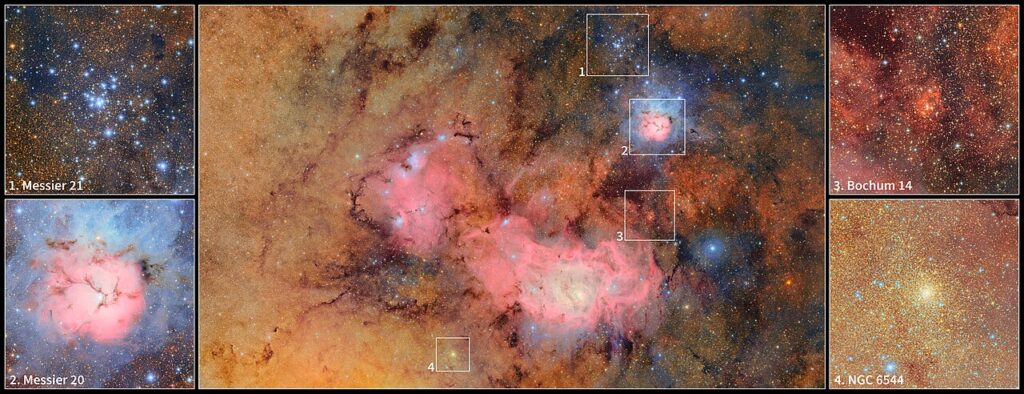
WASHINGTON, June 24—The Vera C. Rubin Observatory released the first public images from its full-size survey camera yesterday, showing richly detailed nebulae and crowded fields of galaxies from its mountain site in Chile. The release demonstrates the wide-field imaging system ahead of its planned long-term survey.
Rubin's 3.2-gigapixel camera is designed to revisit large areas of sky repeatedly. The ambition is not simply to obtain one impressive view. Comparing images over time can reveal moving objects, changing brightness and brief events that would be missed by observations made only once.
The observatory is supported by the U.S. National Science Foundation and Department of Energy, with international participation. Its planned Legacy Survey of Space and Time will produce a large stream of measurements and alerts, creating challenges in data handling as well as opportunities for discovery.
The first images are a demonstration, not the completed survey. They show that the instrument can capture a great deal at once. The scientific value of the programme will emerge from returning to the same sky and learning what has changed between visits.
Sources & further reading
- Ever-changing Universe Revealed in First Imagery From NSF–DOE Vera C. Rubin Observatory — NSF–DOE Vera C. Rubin Observatory, 2025-06-23.
- 2025 in Review: Highlights from an exciting year — NSF–DOE Vera C. Rubin Observatory.
- Excerpts from Trifid and Lagoon Nebulae: noirlab2521d — RubinObs/NOIRLab/SLAC/NSF/DOE/AURA, 2025-06-23.
- Media Use Policy — NSF–DOE Vera C. Rubin Observatory.