

The Aeon Herald / HISTORICAL EDITION
Platform Holly at Sixty: The Wells Are Closed, the Removal Still Ahead
From its installation in 1966 through the latest documented plans in 2026, the Goleta oil platform has moved from production to the unfinished work of decommissioning.
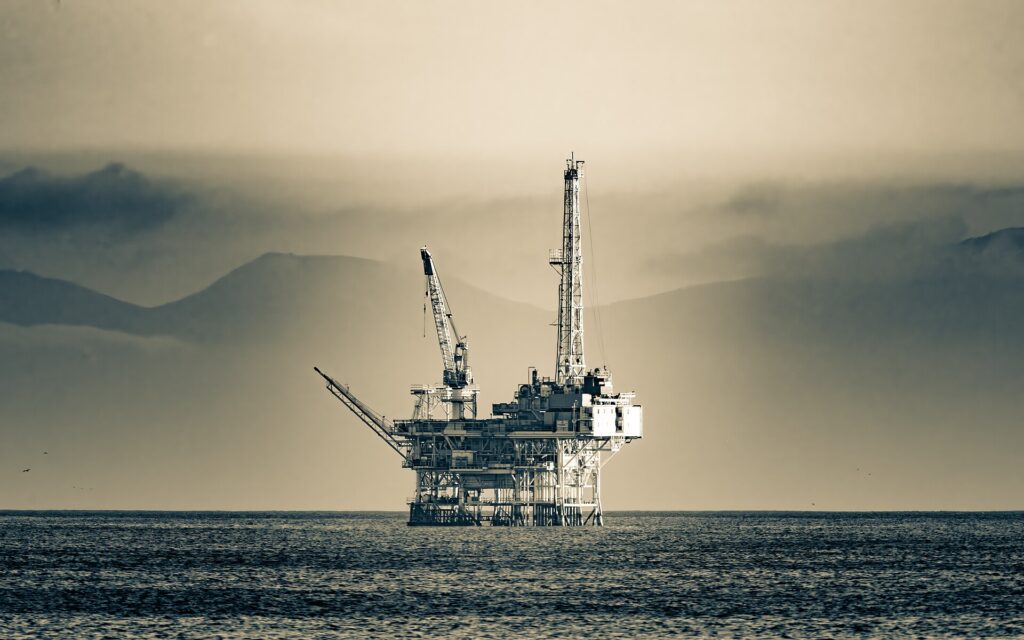
GOLETA, Oct. 26.— Sixty years after its installation, Platform Holly remains off the Goleta coast, but its purpose has changed. The wells have been sealed and the working connection to the oil field severed. California is now considering how to dismantle the structure and its associated offshore equipment. The state’s 2026 project records describe a removal proposal undergoing environmental review, rather than a platform already taken away.
The platform was built in 1966 by Mobil Oil and Atlantic Richfield Company in the South Ellwood Field. Mobil installed it and ARCO operated the completed facilities. Mobil acquired ARCO’s interests in 1993 and transferred the facilities and state leases to Venoco in 1997. The succession of operators would eventually matter as much to the retirement of the platform as it had to its working life.
Holly stands about two miles offshore in approximately 211 feet of water. Its position places it in California state waters, rather than among the federal offshore leases farther out in the channel. From land it is a single industrial landmark. The state’s project description encompasses a larger network extending across the seabed and back to the beach.
The route to market changed over the years. A State Lands Commission staff report records shipment through the Ellwood Marine Terminal before 2012, followed by pipeline transportation through the Las Flores Canyon system. That dependence on connected infrastructure proved decisive in May 2015, when the Plains Line 901 rupture interrupted the transportation system and Holly ceased production. The Refugio spill occurred on an onshore pipeline; it was not a blowout of Holly’s wells.
In April 2017, Venoco surrendered its South Ellwood lease interests and entered bankruptcy. Operational responsibility reverted to the State Lands Commission. The agency retained a contractor to secure and maintain Holly and the onshore facility. ExxonMobil, as successor to an earlier lessee, agreed to undertake abandonment obligations. The state’s account distinguishes those responsibilities from its obligations for wells Venoco had re-drilled.
Plugging work at Holly began in October 2019. The coronavirus pandemic interrupted operations in March 2020, but it did not remove the need for people to monitor the site. The commission maintained around-the-clock staffing during the hiatus because the wells still presented a hydrogen sulfide hazard. A platform can stop selling petroleum long before it can safely be left without its former operating organization.
By June 2023, a state account reported that all 30 wells had been blocked and that the hazard of a hydrogen sulfide release from them had been removed. Final abandonment work continued. Goleta’s municipal newsletter documented a further milestone in late summer 2024: permanent plugging of the wells, removal of the conductors connecting them to the seabed, and preparations to secure the remaining structure. Closing the wells and dismantling the platform were separate stages.
An August 25 State Lands Commission review confirms that full platform removal remains in environmental review. A February 2026 state agency briefing describes Holly in a cold-stacked caretaker condition, with the conductors gone. The platform had been powered down since November 2024, with navigation and safety systems supplied by solar power. Staff continued visiting to maintain those precautions and check its condition. The remaining offshore structure therefore still required care, even after petroleum production and well-abandonment operations had ended.
Environmental review formally advanced on January 22, 2026, when the State Lands Commission issued notice that it would prepare a draft environmental impact report for decommissioning. Two scoping sessions took place at Goleta City Hall on February 19. After an extension, the initial comment period closed March 6. Those proceedings gathered questions for the environmental analysis; they did not themselves authorize a final removal operation.
The proposed project would take Holly down to five feet below the seabed and remove associated pipelines, power cables, and two large seep-collection tents. The tents were installed in 1982 to capture naturally emerging hydrocarbons. They are another reason the cleanup cannot be understood simply as lifting away the platform visible from shore. The offshore equipment and beach crossings must also be considered. Review will also consider partial removal to 85 feet below the sea surface, leaving the lower steel structure in place. That is an alternative for study, not an approved reef project.
Environmental review must examine the consequences of the work as well as the consequences of leaving infrastructure in place. The commission’s earlier planning report identified marine life, sensitive habitat, cultural resources, scenery and air quality among the matters requiring analysis, together with alternatives and measures to reduce harm. A March 2026 county air-district status report likewise lists Holly’s wells as plugged and abandoned while placing platform decommissioning after environmental review.
No final dismantling timetable has been announced. Holly’s history has reached a different kind of engineering problem: how to finish the retirement of an offshore industrial system after its productive life has ended. The wells are closed. The remaining decisions concern the structure, the seabed, the shoreline connections and the marine environment that surrounds them.
Sources & further reading
- Platform Holly Decommissioning Project Notice of Preparation — California State Lands Commission, 2026-01-22.
- Platform Holly Decommissioning Project, SCH 2026010775 — California State Clearinghouse, 2026-01-23.
- Staff Report 40 — J. Fabel and E. Gillies, California State Lands Commission, 2022-08-23.
- South Ellwood Project — California State Lands Commission.
- Milestone Decommissioning Projects on the Central Coast — Office of Lieutenant Governor Eleni Kounalakis, 2023-06-07.
- Goodbye Platform Holly — City of Goleta, The Monarch Press, 2024-09.
- Oil Spill Technical Advisory Committee Agency Briefings — California Office of Spill Prevention and Response / State Lands Commission, 2026-02-19.
- Platform Holly Decommissioning Project: Extended Comment Period — California State Lands Commission, 2026-02-12.
- Oil and Gas Operations Status Update — Aeron Arlin Genet, Santa Barbara County Air Pollution Control District, 2026-03-19.
- Rincon Island and Beyond: A Retrospective on a Decade of Offshore Mineral Management, Staff Report 53 — California State Lands Commission, 2026-08-25.