The Aeon Herald / HISTORICAL EDITION
Webb’s First Images Reveal a Crowded, Distant Universe
The telescope's opening picture release demonstrates the reach of its infrared instruments.
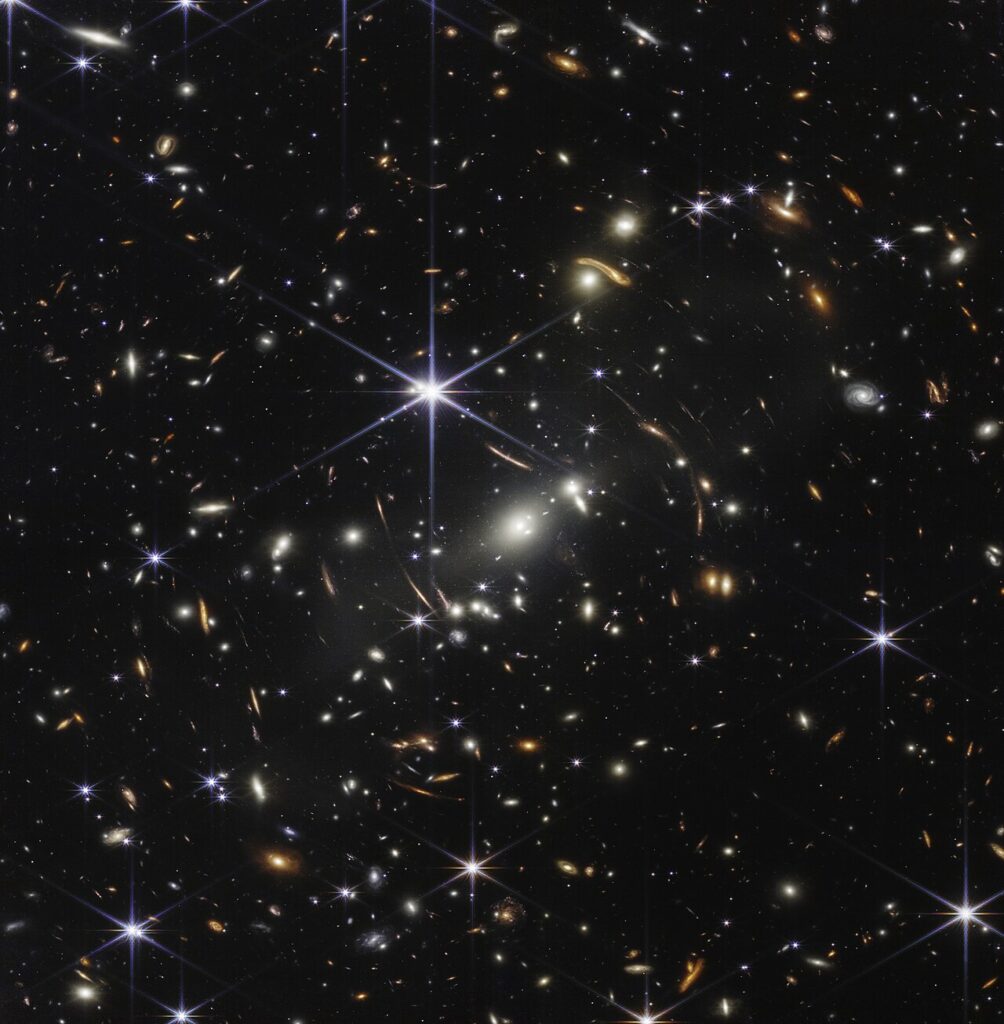
GREENBELT, Md., July 13—The first full set of images from the James Webb Space Telescope has been released, showing distant galaxies, stellar nurseries and the remains of dying stars in extraordinary detail. The opening deep-field view centres on the galaxy cluster SMACS 0723, whose gravity magnifies more distant objects behind it.
The images follow months of deployment, alignment and instrument checks after launch. Webb's large segmented mirror and cold operating environment are designed for infrared observations, allowing it to investigate objects and processes that appear differently or remain difficult to see at visible wavelengths.
The first deep field is crowded with galaxies across a very small patch of sky. It is not a photograph of a single moment in cosmic history: light from different objects has taken different lengths of time to reach the telescope. Spectra will be needed to establish many of the physical details suggested by the pictures.
The release is a demonstration of an observatory entering use. Its most valuable findings will depend on the observations and analysis that follow, including results less immediately photogenic than these first public views.
Sources & further reading
- NASA Reveals Webb Telescope’s First Images of Unseen Universe — NASA, 2022-07-12.
- Webb’s First Deep Field: image file description and use terms — NASA, ESA, CSA and STScI, 2022-07-11.
- NASA Images and Media Usage Guidelines — NASA.
Related Herald reporting
- A Millisecond Radio Flash Opens a Question in the Distant Universe — Adrian Mercer, 2007-09-29.