The Aeon Herald / HISTORICAL EDITION
A Millisecond Radio Flash Opens a Question in the Distant Universe
A powerful pulse found in old Parkes telescope recordings appears to have crossed far more space than the survey originally set out to examine.
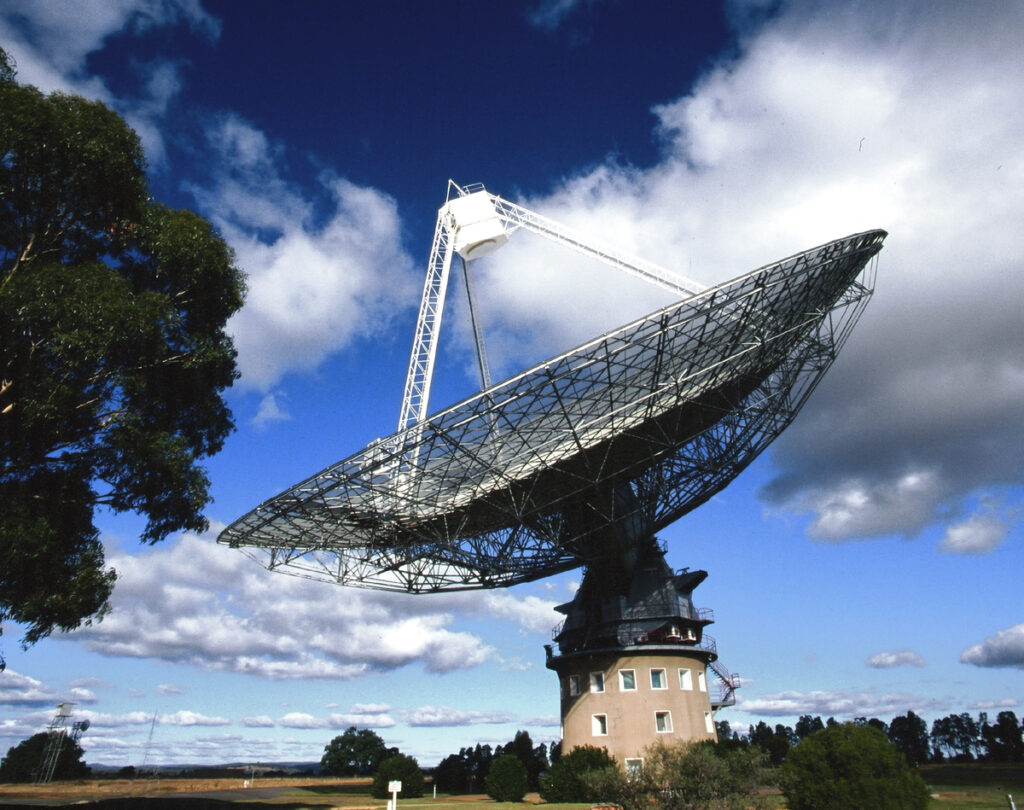
A flash of radio energy lasting less than five thousandths of a second has emerged from archived observations taken with Australia’s Parkes telescope. Astronomers led by Duncan Lorimer report that its properties favor an origin beyond both the Milky Way and the nearby Small Magellanic Cloud, leaving an unusually powerful event to explain.
The discovery comes from a fresh search through data collected in 2001. The telescope had been surveying for pulsars, whose repeating radio pulses help reveal spinning neutron stars. A different examination of those recordings exposed a single bright burst, showing how an old observation can contain a discovery its original search did not recognize.
The pulse did not reach the receiver simultaneously at every frequency. Its lower-frequency components arrived later, a pattern produced when radio waves travel through free electrons. The amount of that delay is central to the researchers’ argument that the signal crossed a much greater distance than an ordinary source in the survey field.
Distance is nevertheless an inference from the propagation model, rather than a measurement of an identified host galaxy. The team places the source within roughly a gigaparsec under its assumptions. A precise address and the physical engine remain unknown.
The CSIRO account describes a burst so bright that it saturated the equipment and initially resembled interference. Proposed explanations include violent events involving compact stellar remnants. The team considers rare, energetic events involving compact stellar remnants as possible sources.
Ninety hours of additional observations produced no further burst from the location. That supports consideration of a one-time catastrophe but cannot establish that the source never repeats. Finding more events in other recordings would give astronomers a population to compare—and a firmer basis for deciding whether this flash marks an unfamiliar kind of cosmic activity.
Sources & further reading
- A Bright Millisecond Radio Burst of Extragalactic Origin — D. R. Lorimer, M. Bailes, M. A. McLaughlin, D. J. Narkevic and F. Crawford / Science; Published online September 27, 2007.
- Mysterious energy burst stuns astronomers — CSIRO Australia / institutional news release; September 28, 2007.
Related Herald reporting
- A More Sensitive Search Leaves the Wow! Signal Unanswered — Adrian Mercer, 2001-01-12.
- The Radio Burst That Came Back Challenges One-Time Explanations — Sarah Nguyen, 2016-03-03.
- The Proxima Signal Leads Investigators Back to Earth — Sarah Nguyen, 2021-10-26.
- Webb’s First Images Reveal a Crowded, Distant Universe — Eric Bennett, 2022-07-13.