

The Aeon Herald / HERALD ORIGINAL
Cassini Ends Its Saturn Tour with a Final Atmospheric Descent
The spacecraft’s last route joined close study of an unexpectedly clear inner gap with a deliberate end that protects the moons.
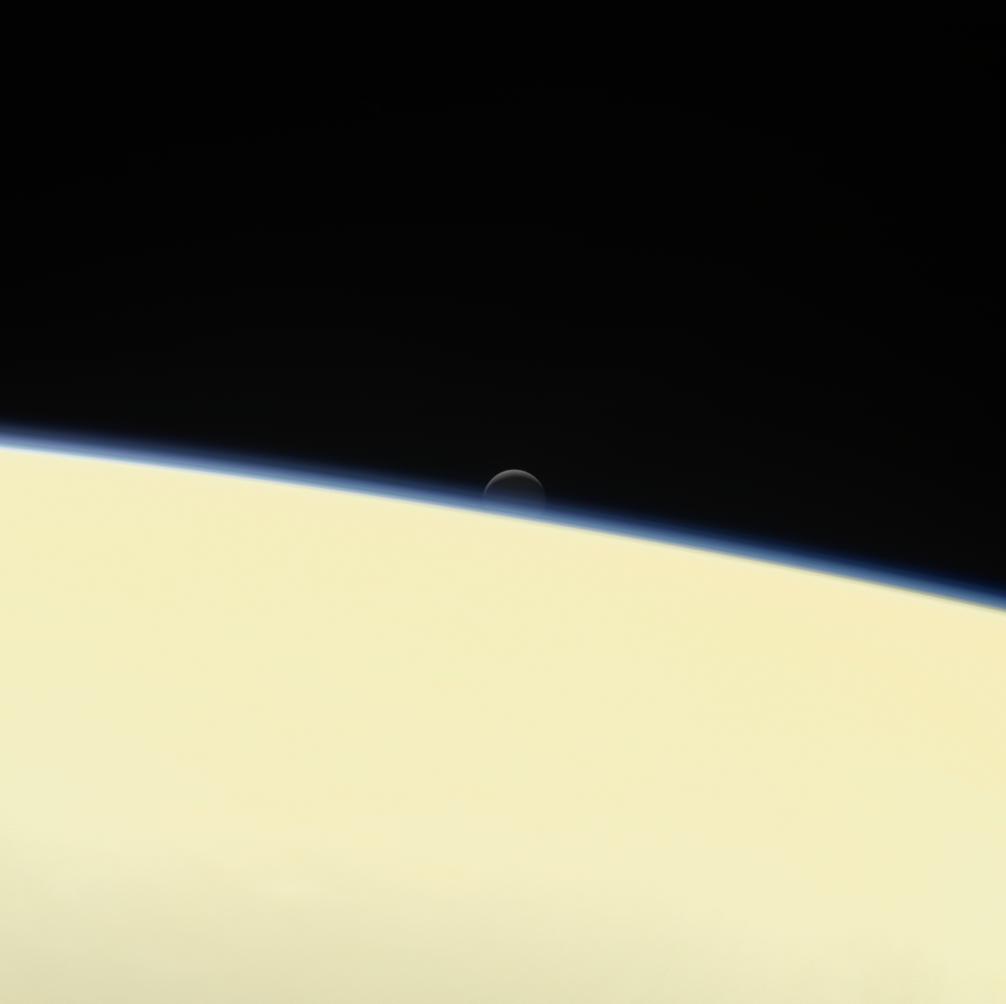
Enceladus sets behind Saturn in one of Cassini's final views, taken September 13, 2017, and released September 15. NASA/JPL-Caltech/Space Science Institute. Image source · Reuse terms.
PASADENA — Cassini’s signal has ended after the spacecraft entered Saturn’s atmosphere on September 15, closing thirteen years of orbital exploration. The final descent was deliberate: mission planners sent the aging spacecraft into the planet rather than leave a chance that it might later strike one of the moons.
The ending followed the Grand Finale, a sequence of close passes between Saturn and its rings. During the first dive on April 26, the spacecraft found far less dust than engineers expected. That result allowed much of the preferred observing program to continue without repeatedly using the large antenna as a shield.
The dust assessment came from the Radio and Plasma Wave Science instrument. Outside the main rings, particle impacts had produced hundreds of detections each second. In the inner gap, investigators counted only a few. Their analysis put the encountered grains on the scale of smoke particles.
The measurements apply to the roughly 2,000-kilometre space between the planet and the rings. They describe the dust encountered on this route; investigators still need to explain why so little material was detected.
The final transmission carried measurements of the atmosphere while the spacecraft could still keep its antenna pointed toward Earth. Loss of the carrier signal confirmed the end for controllers at the Jet Propulsion Laboratory.
The hardware is gone, but analysis is not finished. The mission has left measurements of the rings, moons, atmosphere and magnetic environment for investigators to compare. Its last observations add a region no earlier spacecraft had crossed to that continuing work.
Sources & further reading
- NASA Jet Propulsion Laboratory — NASA’s Cassini Spacecraft Ends Its Historic Exploration of Saturn, September 15, 2017.
- Jia-Rui Cook and Preston Dyches — Cassini Finds ‘The Big Empty’ Close to Saturn, May 1, 2017.
Related Herald reporting
- Saturn’s Icy Rings Show a Familiar Water-Isotope Ratio, with Phoebe an Exception — Sarah Nguyen, 2018-12-04.
- Cassini’s Final Gravity Measurements Point to Relatively Young Rings — Sarah Nguyen, 2019-01-18.
- Enceladus’s Wobble Points to an Ocean Around Its Rocky Interior — Eric Bennett, 2015-09-16.
- A Ten-Sided Wave Emerges Around Saturn’s South Pole — Sarah Nguyen, 2026-09-03.
- Radar Finds a Landscape of Lakes Near Titan’s North Pole — Adrian Mercer, 2007-01-05.
- Enceladus Jets Raise the Possibility of Liquid Water Beneath the Ice — Eric Bennett, 2006-03-11.
- Cassini Finds a Small Moon Inside Saturn’s Keeler Gap — Eric Bennett, 2005-05-11.
- Huygens Reaches Titan and Returns a First View from the Ground — Kevin Wallace, 2005-01-15.
- Cassini Enters Saturn Orbit and Begins a Four-Year Survey — Kevin Wallace, 2004-07-01.
- Hubble Follows a Saturn Storm Around the Planet — Kevin Wallace, 1991-01-18.
- A Star Seen Through Saturn’s Rings Reveals Waves and Narrow Gaps — Paul Norton, 1982-01-30.
- Voyager Finds Ringlets, Spokes and a Shrouded Titan — Paul Norton, 1981-04-11.
- Pioneer’s Saturn Measurements Add a Ring and a Magnetic World — Paul Norton, 1980-01-26.
- Methane Lines Give Saturn’s Atmosphere a Chemical Signature — Edward Hensley, 1933-12-01.
- A White Mark on Saturn Grows Across the Planet’s Face — Edward Hensley, 1933-08-20.
HERALD ORIGINAL
Join the conversation