

The Aeon Herald / HERALD ORIGINAL
Cassini’s Final Gravity Measurements Point to Relatively Young Rings
Radio tracking separates the pull of Saturn’s rings from the planet’s gravity, giving researchers a new basis for estimating their age.
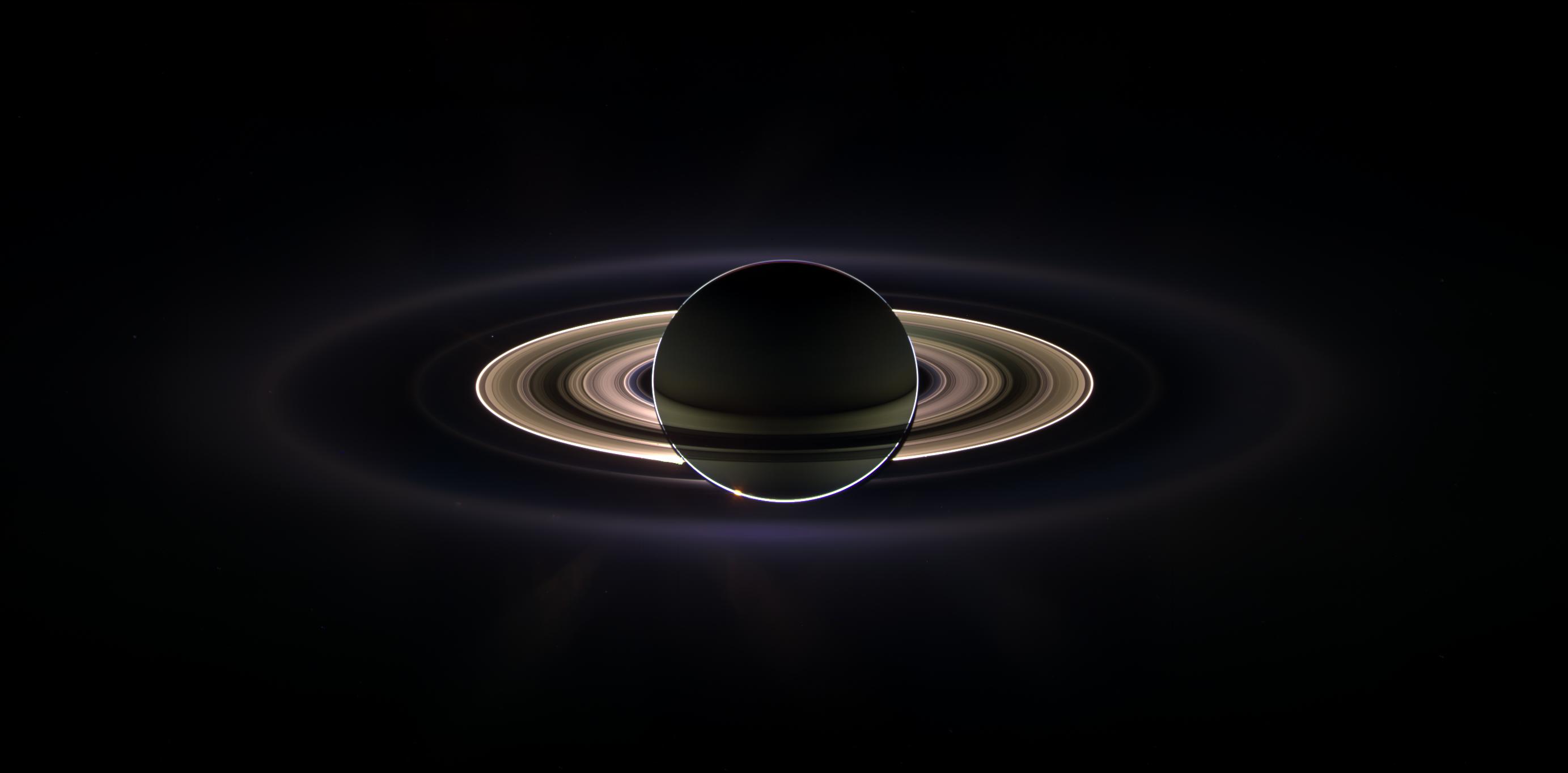
An earlier Cassini mosaic shows Saturn and its rings from the planet's shadow on September 15, 2006. This view was released October 11, 2006. NASA/JPL/Space Science Institute. Image source · Reuse terms.
Saturn’s rings may be much younger than the planet they surround, according to measurements from Cassini’s final orbits. A study published online in Science on January 17 uses the spacecraft’s motion to determine how much material the rings contain.
Luciano Iess and his colleagues reconstructed Cassini’s path from radio signals exchanged with Earth. During earlier orbits the rings and planet pulled from much the same direction, making their effects difficult to separate. Passing between them changed the geometry and allowed a direct estimate of the rings’ mass.
The researchers put that mass at roughly two-fifths of the mass of Saturn’s moon Mimas. Their interior models also indicate that the planet’s rapid atmospheric rotation extends at least nine thousand kilometers beneath the cloud tops. The gravity experiment therefore probes both the rings and the world inside them.
NASA’s account places the inferred ring age between ten million and one hundred million years, compared with about 4.5 billion years for Saturn. The calculation connects ring mass with the amount of darker material expected to accumulate among the bright ice particles.
That is an age inferred from measurements and physical assumptions, rather than a dated observation of the rings’ birth. A smaller mass means less ice is available to dilute incoming contamination; estimating the time required also depends on the supply and retention of that material.
The findings leave the origin unsettled. NASA identifies the disruption of an approaching comet or the breakup of an earlier population of icy moons as possibilities for further study. Cassini’s end in 2017 has closed the observing mission, while the interpretation of its final measurements continues.
Sources & further reading
- L. Iess and colleagues — Measurement and implications of Saturn’s gravity field and ring mass, January 17, 2019; first online release; DOI 10.1126/science.aat2965.
- NASA Jet Propulsion Laboratory — NASA’s Cassini Data Show Saturn’s Rings Relatively New, January 17, 2019.
Related Herald reporting
- Saturn’s Icy Rings Show a Familiar Water-Isotope Ratio, with Phoebe an Exception — Sarah Nguyen, 2018-12-04.
- Cassini Ends Its Saturn Tour with a Final Atmospheric Descent — Eric Bennett, 2017-09-16.
- Enceladus’s Wobble Points to an Ocean Around Its Rocky Interior — Eric Bennett, 2015-09-16.
- A Ten-Sided Wave Emerges Around Saturn’s South Pole — Sarah Nguyen, 2026-09-03.
- Radar Finds a Landscape of Lakes Near Titan’s North Pole — Adrian Mercer, 2007-01-05.
- Enceladus Jets Raise the Possibility of Liquid Water Beneath the Ice — Eric Bennett, 2006-03-11.
- Cassini Finds a Small Moon Inside Saturn’s Keeler Gap — Eric Bennett, 2005-05-11.
- Huygens Reaches Titan and Returns a First View from the Ground — Kevin Wallace, 2005-01-15.
- Cassini Enters Saturn Orbit and Begins a Four-Year Survey — Kevin Wallace, 2004-07-01.
- Hubble Follows a Saturn Storm Around the Planet — Kevin Wallace, 1991-01-18.
- A Star Seen Through Saturn’s Rings Reveals Waves and Narrow Gaps — Paul Norton, 1982-01-30.
- Voyager Finds Ringlets, Spokes and a Shrouded Titan — Paul Norton, 1981-04-11.
- Pioneer’s Saturn Measurements Add a Ring and a Magnetic World — Paul Norton, 1980-01-26.
- Methane Lines Give Saturn’s Atmosphere a Chemical Signature — Edward Hensley, 1933-12-01.
- A White Mark on Saturn Grows Across the Planet’s Face — Edward Hensley, 1933-08-20.
HERALD ORIGINAL
Join the conversation