

The Aeon Herald / HERALD ORIGINAL
Hubble Follows a Saturn Storm Around the Planet
A newly released sequence turns November observations into a moving view of the giant white storm that appeared last September.
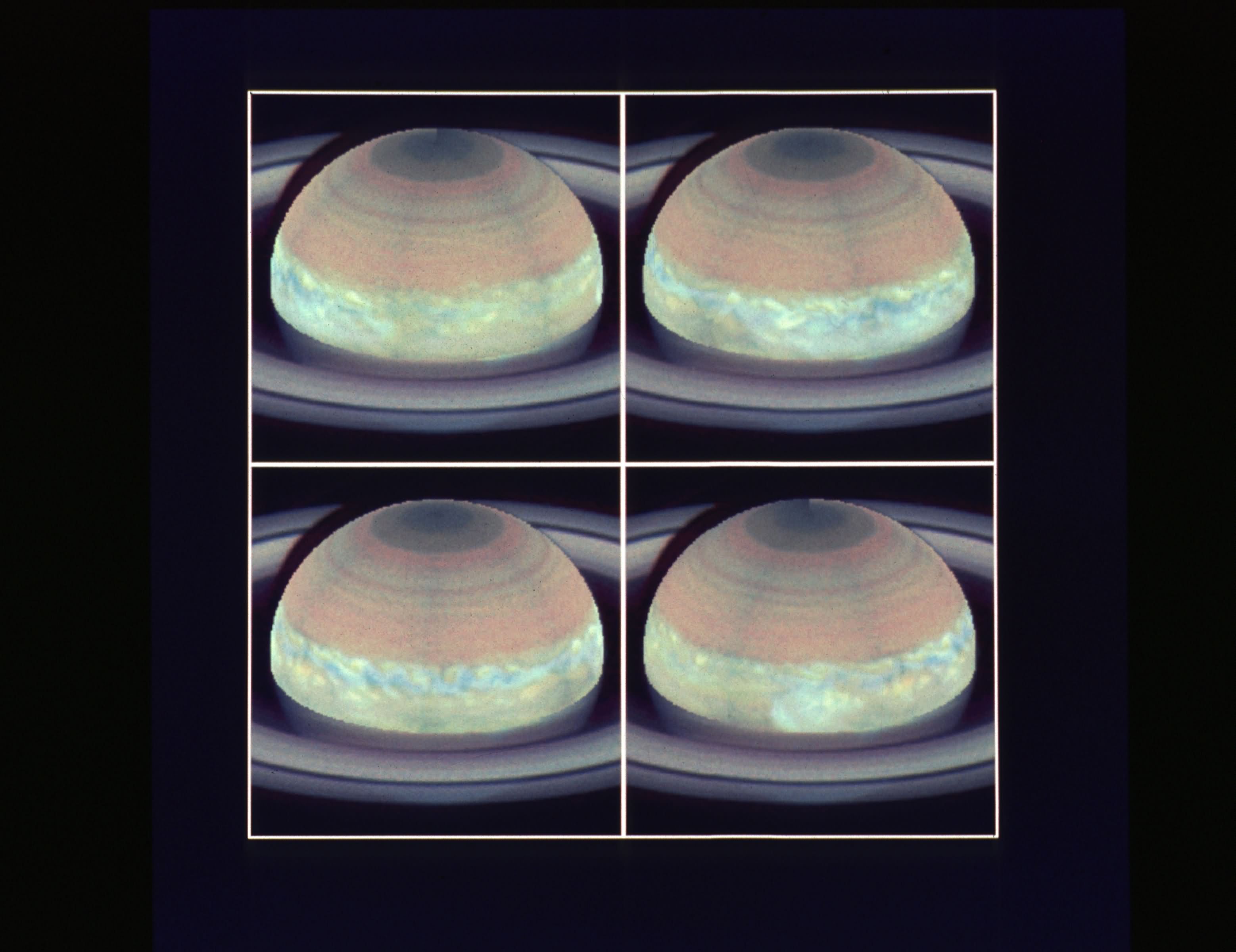
Hubble views of the great storm in Saturn's equatorial region, released January 17, 1991. NASA, ESA, and STScI. Image source · Reuse terms.
A great white storm on Saturn has become a moving subject for the Hubble Space Telescope. NASA has released a sequence assembled from November observations, showing a disturbance that extends around the planet’s equatorial region.
Observers first reported the bright feature in September. The European Southern Observatory reported in November that it had developed from a small marking into an immense band of disturbed clouds. Its observations described a probable atmospheric storm involving material rising from lower levels, while leaving the detailed explanation open.
The European report also placed the event in a sparse historical record. Prominent white spots had been observed in 1876, 1903, 1933 and 1960. This outbreak’s exceptional extent has made it a valuable test of ideas about the atmosphere of a giant planet.
For Hubble, the opportunity required a change of observing schedule. Teams responsible for the telescope and its Wide Field/Planetary Camera arranged several days of observations before Saturn moved too close to the Sun in the sky for safe use of the instrument.
The released movie uses red, green and blue images obtained during eight successive spacecraft orbits on November 17. Processing reduced instrumental effects, including the telescope’s spherical aberration, before the frames were combined. NASA cautions that occasional dark vertical strips come from joining images, rather than from Saturn itself.
The sequence covers one planetary rotation. Further analysis is intended to measure winds and examine cloud heights and composition. A striking picture records the storm’s appearance; explaining why it began and how it spreads will require the measurements behind it.
Sources & further reading
- European Southern Observatory — The White Eye of Saturn, November 9, 1990.
- NASA Hubble Mission Team — NASA’s Hubble Space Telescope Views Major Storm On Saturn, January 17, 1991.
Related Herald reporting
- A Star Seen Through Saturn’s Rings Reveals Waves and Narrow Gaps — Paul Norton, 1982-01-30.
- Voyager Finds Ringlets, Spokes and a Shrouded Titan — Paul Norton, 1981-04-11.
- Pioneer’s Saturn Measurements Add a Ring and a Magnetic World — Paul Norton, 1980-01-26.
- Cassini Enters Saturn Orbit and Begins a Four-Year Survey — Kevin Wallace, 2004-07-01.
- Huygens Reaches Titan and Returns a First View from the Ground — Kevin Wallace, 2005-01-15.
- Cassini Finds a Small Moon Inside Saturn’s Keeler Gap — Eric Bennett, 2005-05-11.
- Enceladus Jets Raise the Possibility of Liquid Water Beneath the Ice — Eric Bennett, 2006-03-11.
- Radar Finds a Landscape of Lakes Near Titan’s North Pole — Adrian Mercer, 2007-01-05.
- Enceladus’s Wobble Points to an Ocean Around Its Rocky Interior — Eric Bennett, 2015-09-16.
- Cassini Ends Its Saturn Tour with a Final Atmospheric Descent — Eric Bennett, 2017-09-16.
- Saturn’s Icy Rings Show a Familiar Water-Isotope Ratio, with Phoebe an Exception — Sarah Nguyen, 2018-12-04.
- Cassini’s Final Gravity Measurements Point to Relatively Young Rings — Sarah Nguyen, 2019-01-18.
- A Ten-Sided Wave Emerges Around Saturn’s South Pole — Sarah Nguyen, 2026-09-03.
- Methane Lines Give Saturn’s Atmosphere a Chemical Signature — Edward Hensley, 1933-12-01.
- A White Mark on Saturn Grows Across the Planet’s Face — Edward Hensley, 1933-08-20.
HERALD ORIGINAL
Join the conversation