

The Aeon Herald / HERALD ORIGINAL
Huygens Reaches Titan and Returns a First View from the Ground
Signals and early pictures establish a successful descent, while the unfamiliar landscape awaits careful interpretation.
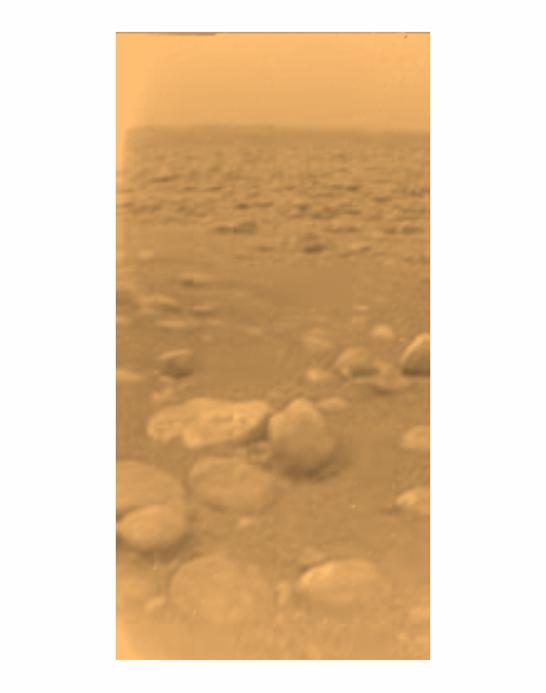
Titan's surface in an image returned by Huygens on January 14, 2005, with the color processing released the following day. NASA/JPL/ESA/University of Arizona. Image source · Reuse terms.
Europe’s Huygens probe has landed on Titan, delivering the first direct view from the surface of Saturn’s largest moon. The European Space Agency announced the successful descent on January 14 after data began arriving at its operations center in Darmstadt, Germany.
Huygens separated from Cassini on December 25 and travelled independently before reaching Titan’s atmosphere. Parachutes slowed the probe after its rapid entry. Cassini received its transmissions and relayed them to Earth through NASA’s Deep Space Network.
The first scientific data reached Darmstadt at 5.19 p.m. Central European Time. A radio signal received earlier by the Green Bank telescope in West Virginia had already shown that the probe was operating during the descent. Transmissions continued after landing while Cassini remained within view.
The agency’s first surface image shows scattered blocks on a relatively level foreground beneath a hazy distance. Investigators describe the objects cautiously as possible ice blocks; their sizes and distances require processing. The raw descent pictures appear to show channels and boundaries between different kinds of terrain, rather than an immediately settled explanation of the landscape.
One image was taken from about 16 kilometers above the surface; another came from about eight kilometers. They begin to connect the ground-level scene with the wider setting through which the probe descended.
Titan’s nitrogen atmosphere and methane chemistry make it an important comparison with the young Earth. Analysis can now connect its atmospheric measurements with the landscape revealed below the haze.
Sources & further reading
- European Space Agency — Europe reaches new frontier – Huygens lands on Titan, January 14, 2005; press release 3–2005.
- European Space Agency — First images from Titan, January 14, 2005.
Related Herald reporting
- Cassini Finds a Small Moon Inside Saturn’s Keeler Gap — Eric Bennett, 2005-05-11.
- Cassini Enters Saturn Orbit and Begins a Four-Year Survey — Kevin Wallace, 2004-07-01.
- Enceladus Jets Raise the Possibility of Liquid Water Beneath the Ice — Eric Bennett, 2006-03-11.
- Radar Finds a Landscape of Lakes Near Titan’s North Pole — Adrian Mercer, 2007-01-05.
- Enceladus’s Wobble Points to an Ocean Around Its Rocky Interior — Eric Bennett, 2015-09-16.
- Cassini Ends Its Saturn Tour with a Final Atmospheric Descent — Eric Bennett, 2017-09-16.
- Saturn’s Icy Rings Show a Familiar Water-Isotope Ratio, with Phoebe an Exception — Sarah Nguyen, 2018-12-04.
- Hubble Follows a Saturn Storm Around the Planet — Kevin Wallace, 1991-01-18.
- Cassini’s Final Gravity Measurements Point to Relatively Young Rings — Sarah Nguyen, 2019-01-18.
- A Ten-Sided Wave Emerges Around Saturn’s South Pole — Sarah Nguyen, 2026-09-03.
- A Star Seen Through Saturn’s Rings Reveals Waves and Narrow Gaps — Paul Norton, 1982-01-30.
- Voyager Finds Ringlets, Spokes and a Shrouded Titan — Paul Norton, 1981-04-11.
- Pioneer’s Saturn Measurements Add a Ring and a Magnetic World — Paul Norton, 1980-01-26.
- Methane Lines Give Saturn’s Atmosphere a Chemical Signature — Edward Hensley, 1933-12-01.
- A White Mark on Saturn Grows Across the Planet’s Face — Edward Hensley, 1933-08-20.
HERALD ORIGINAL
Join the conversation