

The Aeon Herald / HISTORICAL EDITION
Rincon Appeal Ends on a Jurisdiction Question, Leaving County Authority Unsettled
The Ninth Circuit’s treatment of a proposed card room turns on the immediacy of threatened enforcement rather than a broad new gaming entitlement.
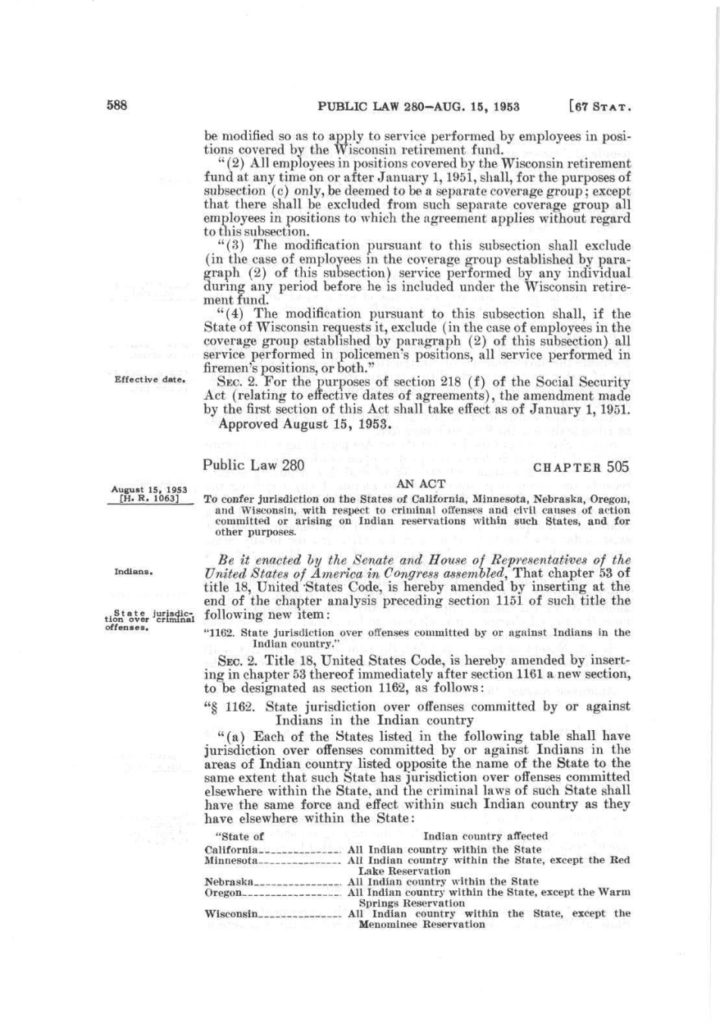
Facsimile from the Public Law 83-280, August 15, 1953, reproduced from the U.S. Statutes at Large. The original statutory page is shown without alteration. Credit: U.S. Congress / Government Publishing Office, GovInfo. Original source. Public domain: official U.S. federal government publication and statutory text. Public domain.
SAN DIEGO COUNTY, June 16.—The Rincon Band’s challenge to a county gambling ordinance has ended in the federal appeals court on the question of whether the record presents an immediate controversy. Rehearing was denied June 11. The result should not be read as a comprehensive decision establishing tribal gaming rights or resolving every limit on county regulation.
The band adopted an ordinance in 1970 authorizing a card room for specified games not prohibited by state law, with revenue intended to benefit the community. Its lawyers sought protection against enforcement of San Diego County’s gambling ordinance on the reservation.
The district court had ruled for the county on the underlying legal issue. On appeal, the majority concluded that the general statements about enforcement did not establish the sufficiently immediate controversy required for a declaratory judgment. It reversed the judgment and dismissed the complaint.
Judge James Browning dissented from that treatment of the Rincon claim. The disagreement concerned the significance of the enforcement threat and whether the band should have to proceed further under the risk of prosecution before obtaining a hearing.
The practical problem for tribal government remains substantial. Planning an economic undertaking requires knowing which authorities can regulate it. A case ending on the sufficiency of its record can leave that problem unresolved even after years of litigation.
Public Law 280 forms part of the dispute’s background, but its grant of jurisdiction cannot be treated as a complete answer without examining the particular authority asserted. Rincon’s case deserves an accurate account of what the court decided and what it left for another proceeding.
Explore the Story
Sources & further reading.
Related Herald reporting
- On Winston Street, Native Women Build a Place to Turn — Katherine “Kate” Romero, 1974-12-15.
- New Law Offers Tribes a Greater Role in Running Federal Programs — Katherine “Kate” Romero, 1975-01-05.
- Federal Review Finds Serious Failures in Sterilization Consent Procedures — Katherine “Kate” Romero, 1976-11-07.
- Blue Lake Return Gives Land to a Policy of Self-Determination — Thomas Navarro, 1970-12-16.
- Indian Civil Rights Act Sets Individual Protections Within Tribal Government — Thomas Navarro, 1968-04-12.
- California Indian Legal Services Builds a Practice Around Tribal Rights — Thomas Navarro, 1967-12-17.
- Section 14 Places Palm Springs’ Growth Beside the Cost of Displacement — Thomas Navarro, 1966-12-18.
- Agua Caliente’s Women Leaders Press for Control of Their Land’s Future — William Keane, 1959-12-13.
- California Rancheria Law Sets Conditions for Ending Federal Trust Relations — Joan Mercer, 1958-08-19.
- New Law Extends California’s Court Jurisdiction Into Indian Country — William Keane, 1953-08-16.
- Congress Announces a Policy of Ending Federal Supervision of Indian Tribes — Edward Hensley, 1953-08-02.
- New Indian Law Halts Allotment and Opens a Different Course for Tribal Government — Samuel Voss, 1934-06-19.
- Women of All Red Nations Connect Health, Family and Political Survival — Katherine “Kate” Romero, 1978-12-10.
Join the conversation