

The Aeon Herald / HERALD ORIGINAL
Nora’s Floods Add an Unusual Tropical Passage to California’s Record
The September storm crossed into the desert Southwest after striking Baja California; flooding reached mountain, desert and coastal communities.
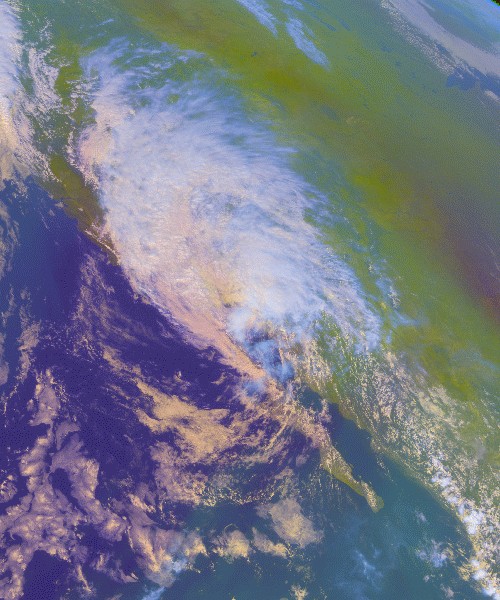


Nora’s September passage left Southern California with a substantial rainfall and flooding event even after the storm had weakened from hurricane strength. Flooding was recorded at Palm Springs, Borrego Springs and Spring Valley during the September 24–26 period. The damage was distributed across several kinds of terrain rather than concentrated at one coastal landfall.
Weather observations give a clearer measure than the hurricane’s earlier offshore strength. The event produced 5.50 inches at Mount San Jacinto, 4.70 at Mount Laguna and 4.41 at Mount San Gorgonio. Twentynine Palms received 3.07 inches and Hemet 2.88. Those are event measurements at different stations; they should not be combined into a regional average or reported as though all fell within a single hour.
The outer bands also ended Los Angeles’s record dry run of 219 days without measurable rain, according to a September 26 Associated Press account. In the Seeley area, fifteen wooden telephone poles fell, while El Centro had leaking roofs and limited flooding. Along part of the Orange County shoreline, high tide coincided with waves reported as high as twenty feet.
The storm struck Baja California on September 25 before entering the United States near the California–Arizona border as a tropical storm. It then weakened to a depression over the desert Southwest. The name Hurricane Nora describes part of its history, not the wind classification at every later point along its path.
Coastal damage also included homes washed by waves at Seal Beach, contemporary reporting recorded. That places the shoreline within the account without making every affected place part of the storm center’s track.
A single California-only dollar total is not established here. Wider estimates can mix losses in Arizona, Mexico and California, and different kinds of agricultural and public damage. The local rainfall records, reported flooding and separate coastal impacts show why Nora belongs in the region’s storm history without converting those different accounts into an unsupported final sum.
Sources & further reading
- WPC Positions for Tropical Depression Nora — Richard Bandy / NOAA NCEP Hydrometeorological Prediction Center; September 26, 1997.
- The Weather Guide: History of Significant Weather Events in Southern California — Miguel Miller / National Weather Service, San Diego; 2012 sixth edition, historical September 1997 entry.
- Hurricane Nora—September 14–28, 1997: Tropical Cyclone Rainfall — David M. Roth / NOAA Weather Prediction Center; Historical event account; updatedMay 12, 2022.
- Nora Sweeps By, Bringing Rain and Floods — Eric Malnic and Tony Perry / Los Angeles Times; September 26, 1997.
- Hurricane Nora Swamps Arizona: Expected To Tone Down As It Moves North Up Colorado River Valley — Jerry Nachtigal / Associated Press; September 26, 1997.
Related Herald reporting
- Doreen Adds a Second Season of Flood Damage in the Imperial Valley — Gary Preston, 1977-09-11.
- Kathleen Study Finds Speed and Inland Strength Behind September’s Damage — Gary Preston, 1977-03-01.
- Kay’s Rain Leaves a Debris-Flow Disaster Beyond the Coast — Jennifer Dalton, 2022-09-18.
- Hilary Reanalysis Changes the Track’s Label, Leaving the Flood Damage Intact — Jennifer Dalton, 2024-02-23.
- September’s Tropical Storm Leaves a Coastal Disaster in the Year’s Record — William Keane, 1939-12-31.
HERALD ORIGINAL
Join the conversation