

The Aeon Herald / HERALD ORIGINAL
Third Interstellar Visitor Follows a Safe Route Through the Solar System
3I/ATLAS has a comet-like cloud and a hyperbolic orbit; its origin makes it rare, while its calculated path keeps it far from Earth.
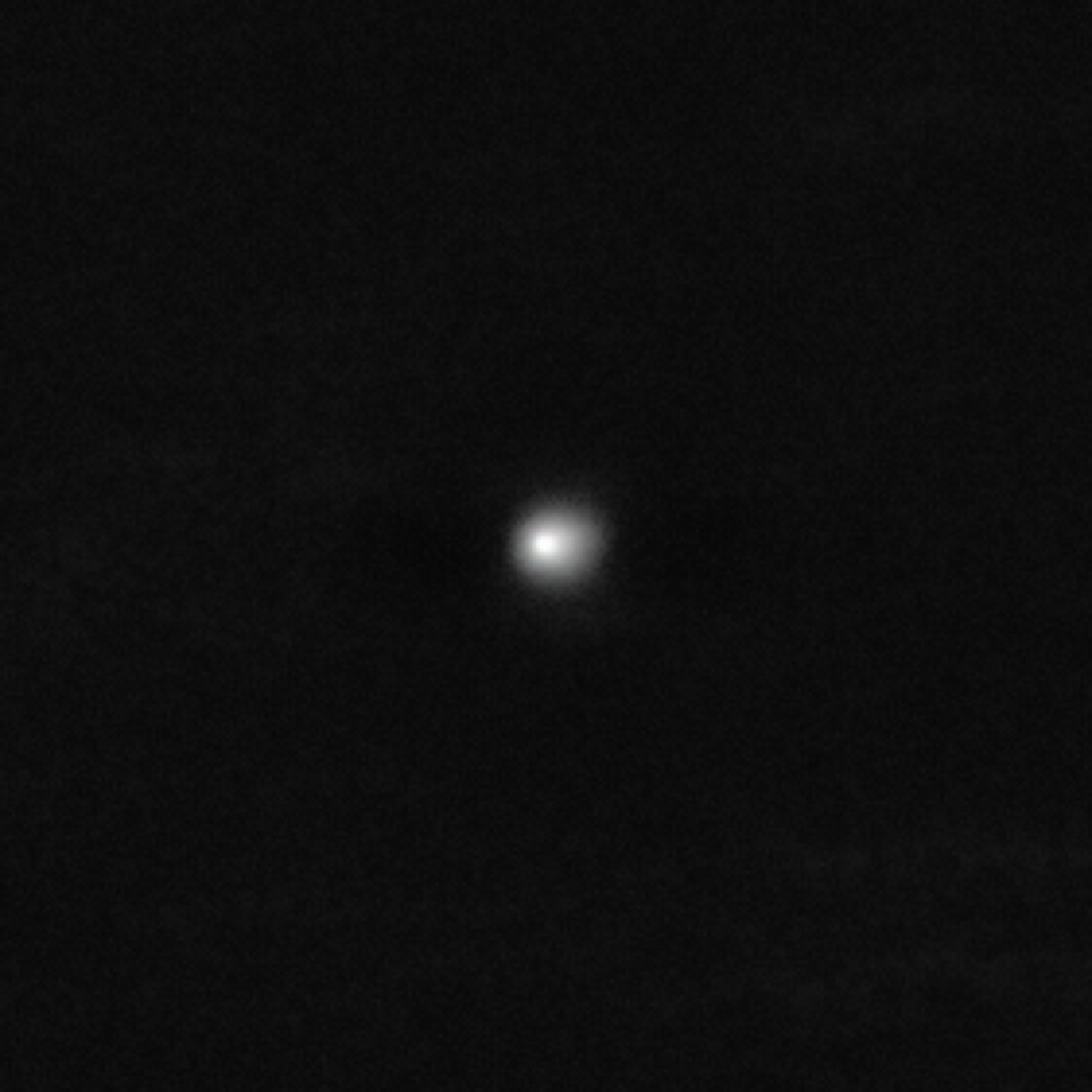
Interstellar comet 3I/ATLAS in images taken with the Very Large Telescope on the night of July 3, 2025. ESO combined the observations and removed the background stars. It released the image on July 8, three days after this edition appeared. ESO/O. Hainaut. CC BY 4.0. Image source · CC BY 4.0. Later addition to the Herald archive.
Astronomers have identified a third known visitor from interstellar space, a comet designated 3I/ATLAS. The ATLAS survey telescope at Río Hurtado, Chile, first reported it July 1. Its unusually fast, open trajectory indicates that it is passing through the Solar System rather than making a recurring orbit around the Sun.
NASA’s initial announcement places the comet beyond 400 million miles from the Sun, in the region inside Jupiter’s orbital distance. It is approaching the inner Solar System, but does not present a danger to Earth. The early orbit keeps it at least 1.6 astronomical units from our planet—about 240 million kilometers, or 150 million miles.
The object also carries the comet designation C/2025 N 1 (ATLAS). Observations show signs of a surrounding cloud of gas and dust. That visible activity distinguishes it from the first interstellar discovery, ʻOumuamua, whose physical nature proved difficult to classify. The second known visitor, 2I/Borisov, was clearly cometary.
A preliminary scientific report describes a strongly hyperbolic orbit, with an eccentricity around 6.2 and a speed outside the Sun’s gravitational influence near 60 kilometers a second. Those values are part of an early solution that will be refined as more positions are measured. They establish an unbound visitor without identifying the particular star or planetary system from which it came.
The discovery is an opportunity to organize telescope observations while the comet is still inbound. Its brightness includes the cloud surrounding the nucleus, so the size of that cloud cannot simply be reported as the diameter of solid material. Establishing the nucleus’s size, composition and activity will require more than the discovery measurements.
The survey’s name—Asteroid Terrestrial-impact Last Alert System—describes its broader search purpose, not a warning that every discovery is about to strike. A rare origin and a hazardous trajectory are separate questions. In this case the available orbit establishes a safe passage while giving astronomers another chance to compare material from outside the Solar System with the comets already known at home.
Sources & further reading
- NASA Discovers Interstellar Comet Moving Through Solar System — NASA Planetary Defense Coordination Office; July 2, 2025.
- Discovery and Preliminary Characterization of a Third Interstellar Object: 3I/ATLAS — Darryl Z. Seligman et al.; July 3, 2025 preprint.
Related Herald reporting
- ʻOumuamua’s Small Extra Acceleration Favors a Cometary Explanation — Sarah Nguyen, 2018-06-28.
- An Object From Another Star System Passes Through Ours — Eric Bennett, 2017-11-21.
HERALD ORIGINAL
Join the conversation