

The Aeon Herald / HERALD ORIGINAL
Voyager Finds Ringlets, Spokes and a Shrouded Titan
The first published survey of Voyager’s Saturn encounter reveals structure in apparent gaps and clouds that still conceal Titan’s surface.
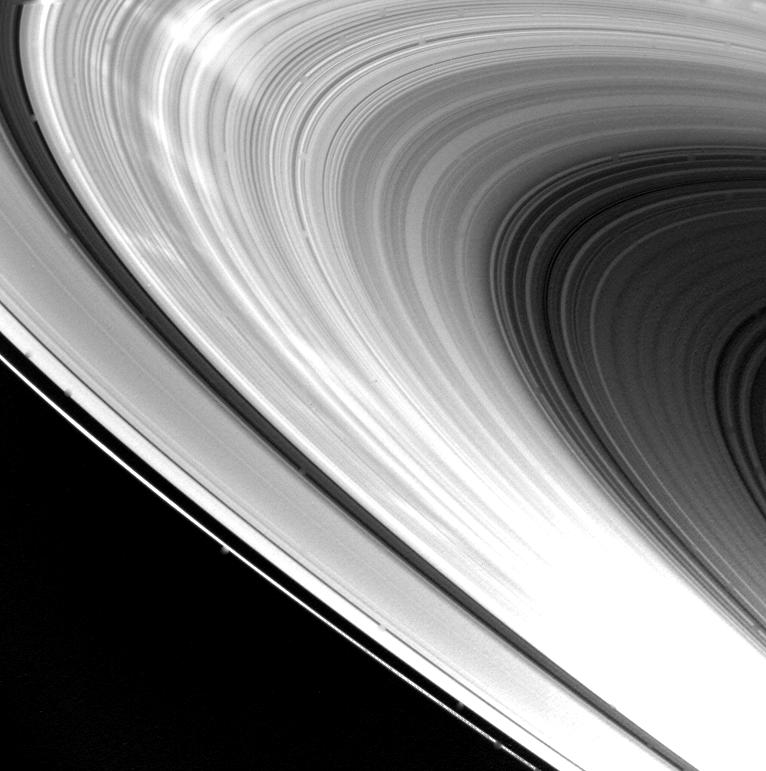
Voyager 1 photographed Saturn’s rings on November 12, 1980, eight hours after closest approach. NASA published this reproduction in its Photojournal in May 2000. NASA/JPL, PIA02269. Image source · NASA/JPL informational/editorial image reuse permission. Later addition to the Herald archive.
PASADENA — Saturn’s rings have become a far more intricate system under Voyager 1’s cameras. Reports now appearing in Science describe hundreds of ringlets, irregular features and small moons whose gravity helps shape the material around them.
The spacecraft made its closest approach on November 12, passing about 78,000 miles above the cloud tops. NASA’s encounter summary counts more than 17,500 photographs of Saturn and its satellites between August and December.
The imaging team, headed by B. A. Smith, reports that the broad A, B and C rings contain many narrow structures. The F ring resolves into three components, with a crossing and kinked appearance in at least one instance. Small inner satellites interact with the ring particles as well as with one another.
Some apparent divisions are not empty. NASA reports at least five ringlets within the Cassini Division. It also describes transient markings resembling spokes across the B ring. These look dark in some views and bright in others; the changing scattering of sunlight points to very fine material. Their origin remains under study.
Titan presented a different difficulty. Its dense haze prevented the cameras from seeing the ground, although the encounter established an atmosphere composed chiefly of nitrogen. NASA estimates pressure near the surface at about 1.6 times Earth’s atmospheric pressure.
The pictures also distinguish the icy satellites from one another, with varied crater patterns and evidence that some surfaces have been altered from within. Voyager has turned a distant planetary system into a set of separate scientific problems. Voyager 2’s approach later this year offers an opportunity to test the first encounter’s interpretations.
Sources & further reading
- B. A. Smith and colleagues — Encounter with Saturn: Voyager 1 imaging science results, April 10, 1981; 212(4491), pp. 163–191; original abstract.
- NASA — Preliminary science results of Voyager 1 Saturn encounter, March 30, 1981; News release 81-44, pp. 1, 3–4, 8–10.
Related Herald reporting
- A Star Seen Through Saturn’s Rings Reveals Waves and Narrow Gaps — Paul Norton, 1982-01-30.
- Pioneer’s Saturn Measurements Add a Ring and a Magnetic World — Paul Norton, 1980-01-26.
- Hubble Follows a Saturn Storm Around the Planet — Kevin Wallace, 1991-01-18.
- Cassini Enters Saturn Orbit and Begins a Four-Year Survey — Kevin Wallace, 2004-07-01.
- Huygens Reaches Titan and Returns a First View from the Ground — Kevin Wallace, 2005-01-15.
- Cassini Finds a Small Moon Inside Saturn’s Keeler Gap — Eric Bennett, 2005-05-11.
- Enceladus Jets Raise the Possibility of Liquid Water Beneath the Ice — Eric Bennett, 2006-03-11.
- Radar Finds a Landscape of Lakes Near Titan’s North Pole — Adrian Mercer, 2007-01-05.
- Enceladus’s Wobble Points to an Ocean Around Its Rocky Interior — Eric Bennett, 2015-09-16.
- Cassini Ends Its Saturn Tour with a Final Atmospheric Descent — Eric Bennett, 2017-09-16.
- Saturn’s Icy Rings Show a Familiar Water-Isotope Ratio, with Phoebe an Exception — Sarah Nguyen, 2018-12-04.
- Cassini’s Final Gravity Measurements Point to Relatively Young Rings — Sarah Nguyen, 2019-01-18.
- A Ten-Sided Wave Emerges Around Saturn’s South Pole — Sarah Nguyen, 2026-09-03.
- Methane Lines Give Saturn’s Atmosphere a Chemical Signature — Edward Hensley, 1933-12-01.
- A White Mark on Saturn Grows Across the Planet’s Face — Edward Hensley, 1933-08-20.
HERALD ORIGINAL
Join the conversation