The Aeon Herald / HISTORICAL EDITION
Palisades Fire Leaves a Neighborhood and Its Public Landscape to Rebuild
Twelve deaths are now attributed to the Palisades fire. Beyond the thousands of destroyed buildings, state parks face losses to historic places, roads and trails.
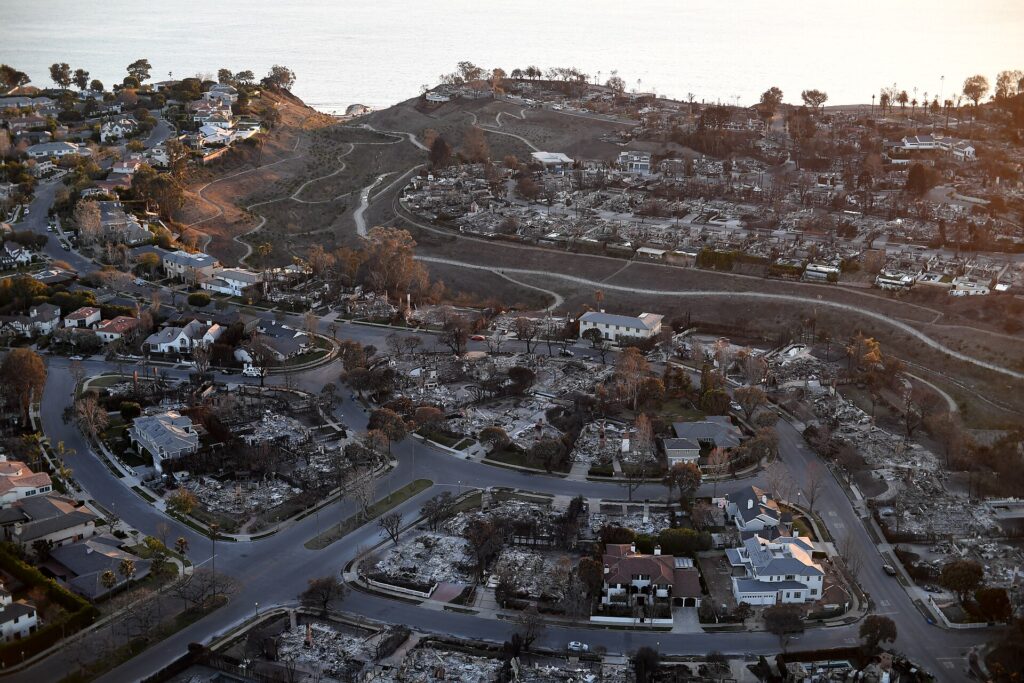
PACIFIC PALISADES — Nearly seven months after the Palisades fire began, the record of its losses still connects private homes with places held for the public. More than 6,800 structures were destroyed across a 23,448-acre footprint. The county medical examiner's July 22 update attributes twelve deaths to the fire. Those figures describe a disaster whose recovery extends from individual properties into the surrounding parkland.
The fire began on the morning of January 7 southeast of Palisades Drive. It was fully contained January 31. The intervening weeks brought destruction to developed neighborhoods and to the historic buildings, roads and trails through which people have experienced the coast and mountains. The final perimeter contains both kinds of loss; rebuilding them involves different owners, different purposes and a shared damaged landscape.
At Will Rogers State Historic Park, the thirty-one-room ranch house burned. The building had carried a particularly recognizable piece of Southern California's entertainment history into a public setting. Staff evacuated horses and removed artifacts before the fire reached the property. Those actions saved living animals and movable objects, but they could not preserve the historic house itself.
The Topanga Ranch Motel was also destroyed. Built in 1929, its thirty rooms stood beside Pacific Coast Highway, representing a different sort of coastal history from the ranch above the Palisades. Their loss joins a place associated with a celebrated entertainer to one associated with the practical accommodations of an earlier highway coast. Both had survived into the state park system before this fire.
The damage extends beyond these most recognizable buildings. A March report to the State Park and Recreation Commission recorded approximately 8,300 burned acres of state park land. Nineteen structures were lost at Will Rogers and twenty-eight at Topanga State Park. The report also described damaged culverts, pedestrian bridges and retaining walls, along with more than forty miles of road and eighty miles of trail.
Those less conspicuous losses help explain why recovery cannot be organized entirely around replacing landmarks. A trail depends upon the condition of the slope it crosses, the drainage beneath it and the bridge that completes its route. Repairing one section does not automatically restore an entire public approach. The work on roads and drainage is part of restoring access, even when it produces no building suitable for a reopening photograph.
The burned residential districts required another kind of preliminary work. Federal crews removed household hazardous materials before the larger debris operation could proceed. The Environmental Protection Agency announced the completion of that first phase across the Palisades and Eaton fire areas in February. It was an initial clearance operation, not a statement that all debris had been removed or that rebuilding was complete.
The distinction is especially important in a disaster encompassing thousands of properties. Clearing hazardous material, removing debris and constructing a habitable building are successive tasks rather than interchangeable announcements. Progress on one does not cancel the remaining work. The same is true on public land, where saving an artifact and restoring the building that displayed it are separate achievements.
There is no single reconstruction that will stand for all of these places. A household needs a home; a historic park needs a way to explain what was lost as well as preserve what remains; a public trail needs a safe, continuous route. The fire joined them in January through wind, terrain and burning buildings. Their recovery now joins them through the roads, services and landscape on which each depends.
The July death-toll update is a reminder that even the accounting has continued after containment. The eventual measure of recovery will require more than a smaller debris pile or a rebuilt landmark. It will include the ability of residents to live here again and of the public to regain meaningful access to the coast and hills that surround the community.
Sources & further reading
- Palisades Fire incident record — CAL FIRE.
- Wildfires Update: 31st Death Related to the January Wildfires Confirmed — County of Los Angeles Department of Medical Examiner, 2025-07-22.
- Palisades Fire Destroys Historic Homes and Buildings at Will Rogers and Topanga State Parks — California State Parks, 2025-01-08.
- Palisades Fire Impact on California State Parks, commission staff report — Alex Luscutoff, California State Parks, 2025-03-26.
- EPA Completes Household Hazardous Materials Cleanup in Response to Los Angeles Wildfires — U.S. Environmental Protection Agency, 2025-02.
Related Herald reporting
- Eaton Fire Recovery Reaches From Burned Lots to Classrooms — Jennifer Dalton, 2025-08-03.
- Eaton Fire Containment Leaves Altadena Facing a Long Recovery — Jennifer Dalton, 2025-02-01.
- Park Fire Leaves a 429,603-Acre Scar as Emergency Managers Count the Disruption — Jennifer Dalton, 2024-09-25.
- Post Fire Leaves Hungry Valley Closed for a Different Kind of Recovery — Jennifer Dalton, 2024-07-04.
- Mosquito Fire Leaves Waterworks and Burned Homes in the Repair Account — Jennifer Dalton, 2022-10-24.
- McKinney Crews Turn to Repair After Fire Devastates Klamath River — Jennifer Dalton, 2022-08-30.
- Dixie Fire Burns Through Greenville as Smoke Spreads Across the West — Jennifer Dalton, 2021-08-08.
- Palisades Fire Contained Without the Loss of a Home — Jennifer Dalton, 2021-05-27.
- Bobcat Fire Burns a Route Across the San Gabriels — Jennifer Dalton, 2020-12-27.
- Woolsey Fire Leaves Homes and a Piece of the Movies to Rebuild — Jennifer Dalton, 2019-01-13.
- Camp Fire Search Revises the Toll as Paradise Faces Its Ruins — Jennifer Dalton, 2018-12-05.
- Thomas Fire Ends With a Second Disaster in Its Watershed — Jennifer Dalton, 2018-01-21.
- Station Fire Leaves the Angeles Forest With a Long Recovery — Jennifer Dalton, 2009-10-25.
- Station Fire’s Smoke Spreads Beyond the Flames in Satellite View — Andre Lawson, 2009-09-02.
- Catalina’s Fire Scar Leaves a Long Recovery Beyond Avalon — Jennifer Dalton, 2007-11-12.
- Witch Fire Carries a Backcountry Emergency Into Rancho Bernardo — Jennifer Dalton, 2007-11-11.
- Old Fire Leaves a Burned Route From Valley to Mountain — Jennifer Dalton, 2003-11-23.
- Cedar Fire Crosses the Distance Between Forest and City — Jennifer Dalton, 2003-11-16.