

The Aeon Herald / HISTORICAL EDITION
Agua Caliente’s Women Leaders Press for Control of Their Land’s Future
The Palm Springs tribal council’s work on leases and government shows women exercising sustained political leadership in Southern California.
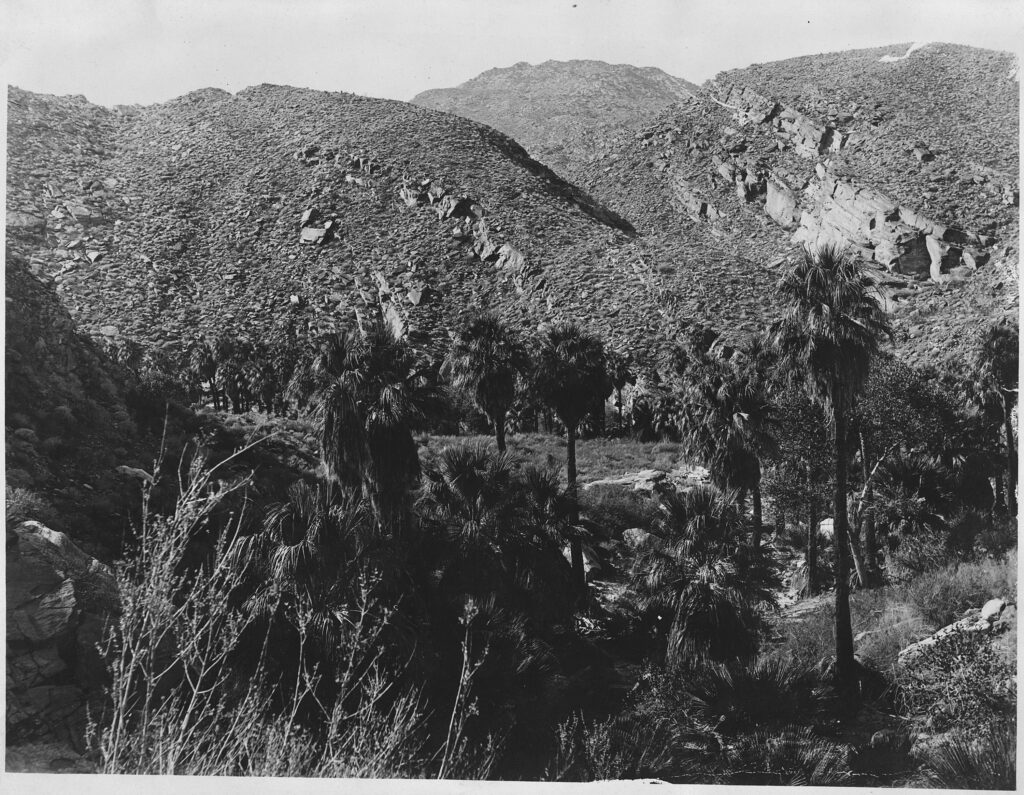
Palm Canyon near Palm Springs, circa 1920. Earlier landscape context for Agua Caliente land and government; the council’s women leaders are not pictured. Credit: U.S. National Archives, photograph 298616. Original source. Public domain: U.S. government work, NARA record 298616.
PALM SPRINGS, Dec. 13.—The future of valuable land in the center of this resort city is being argued by women whose authority comes from the Agua Caliente Band of Cahuilla Indians. Their work concerns leases, federal restrictions and the means by which tribal members can benefit from property held in trust for them.
The band elected an all-women council in 1954. Its members included Chairman Vyola Olinger, Eileen Miguel, LaVerne Saubel, Flora Patencio and Elizabeth Pete Monk. Women’s leadership has continued through succeeding councils, placing them in negotiations with federal officers, city interests and prospective investors.
Short leasing terms have made sustained development difficult. The council pressed for longer arrangements, and federal legislation in 1955 permitted leases of twenty-five years with a possible renewal. The negotiations concern the ability to plan and finance improvements without giving up the land itself.
That distinction is essential in Palm Springs. A developer may see a parcel as a site for construction; its owner also sees an inheritance and a continuing connection. The terms of a lease determine who receives income, who bears obligations and how much authority remains with the landholder.
The council’s record also challenges the tendency to describe Indian affairs as a discussion conducted entirely among men. These women are making decisions, explaining their position before public bodies and dealing with institutions that have often assumed the right to decide for them.
Economic independence will not arrive through admiration of their determination alone. It depends on enforceable terms, competent advice and respect for the band’s governmental choices. Those details deserve the same attention given to Palm Springs’ newest hotel or subdivision.
Explore the Story
Sources & further reading.
Related Herald reporting
- New Law Extends California’s Court Jurisdiction Into Indian Country — William Keane, 1953-08-16.
- The Federal Relocation Promise Meets the Cost of Living in Los Angeles — Lillian Marsh, 1956-08-12.
- California Rancheria Law Sets Conditions for Ending Federal Trust Relations — Joan Mercer, 1958-08-19.
- Congress Announces a Policy of Ending Federal Supervision of Indian Tribes — Edward Hensley, 1953-08-02.
- Section 14 Places Palm Springs’ Growth Beside the Cost of Displacement — Thomas Navarro, 1966-12-18.
- California Indian Legal Services Builds a Practice Around Tribal Rights — Thomas Navarro, 1967-12-17.
- Indian Civil Rights Act Sets Individual Protections Within Tribal Government — Thomas Navarro, 1968-04-12.
- Blue Lake Return Gives Land to a Policy of Self-Determination — Thomas Navarro, 1970-12-16.
- Rincon Appeal Ends on a Jurisdiction Question, Leaving County Authority Unsettled — Katherine “Kate” Romero, 1974-06-16.
- New Law Offers Tribes a Greater Role in Running Federal Programs — Katherine “Kate” Romero, 1975-01-05.
- New Indian Law Halts Allotment and Opens a Different Course for Tribal Government — Samuel Voss, 1934-06-19.
Join the conversation