

The Aeon Herald / HISTORICAL EDITION
California Rancheria Law Sets Conditions for Ending Federal Trust Relations
A new act provides for distribution of assets at named rancherias and reservations, with preparations required before termination.
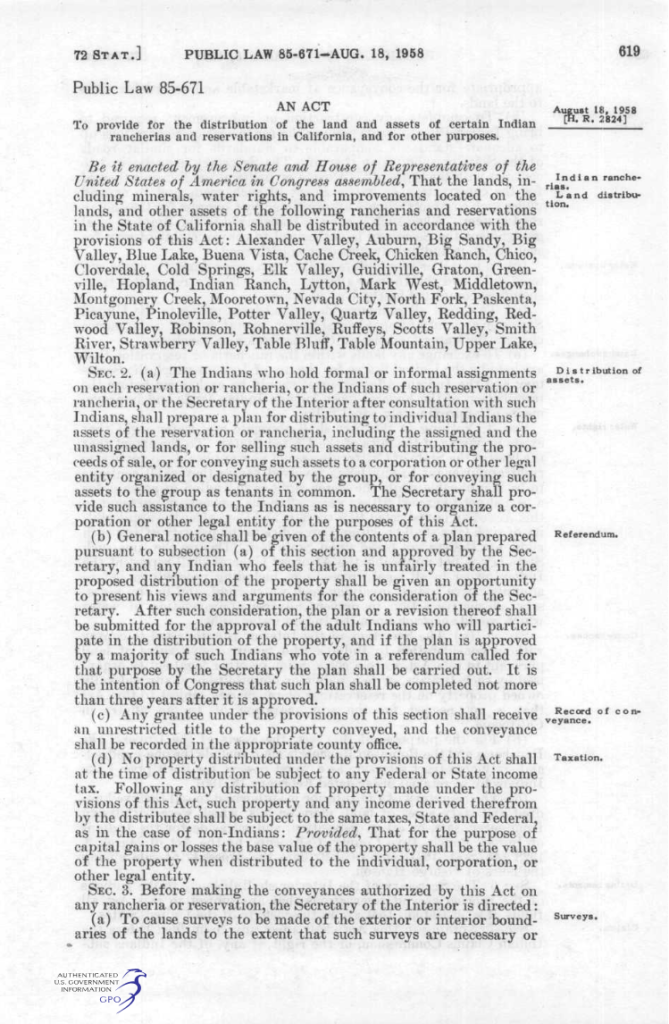
Facsimile from the California Rancheria Act, August 18, 1958, reproduced from the U.S. Statutes at Large. The original statutory page is shown without alteration. Credit: U.S. Congress / Government Publishing Office, GovInfo. Original source. Public domain: official U.S. federal government publication and statutory text. Public domain.
WASHINGTON, Aug. 19.—Legislation approved yesterday provides for distributing the lands and assets of specified California rancherias and reservations to individual Indians. The act establishes a process leading toward an end to federal supervision for affected property and people, placing the details of preparation at the center of the question.
The law names the communities to which it applies. It does not terminate every California tribe. Its provisions call for plans concerning distribution of assets and address matters including water, roads and other facilities before the federal relationship is ended under its terms.
Those requirements are consequential. A parcel of land cannot support a household merely because ownership has been recorded in a new form. Access, water and the obligations attached to property will help determine whether an individual receives a usable asset or an unmanageable burden.
Termination can also change the availability of services and the protections attached to trust property. The language of individual ownership must be considered alongside those losses. Citizenship and an end to a tribal relationship are different questions, even when legislation places them together.
For communities considering a distribution plan, the terms should be explained before consent is sought. Families require clear accounts of what will remain, what will end, and which government is responsible for completing the promised preparations.
The act opens an administrative process whose results cannot yet be reported as settled. The proper follow-up will examine each affected community and each obligation. Southern California readers should understand this as part of statewide federal policy, without assuming that every local reservation has been placed under the same measure.
Explore the Story
Sources & further reading.
Related Herald reporting
- The Federal Relocation Promise Meets the Cost of Living in Los Angeles — Lillian Marsh, 1956-08-12.
- A Younger Generation Organizes to Speak for Itself — Thomas Navarro, 1961-09-03.
- Section 14 Places Palm Springs’ Growth Beside the Cost of Displacement — Thomas Navarro, 1966-12-18.
- Agua Caliente’s Women Leaders Press for Control of Their Land’s Future — William Keane, 1959-12-13.
- New Law Extends California’s Court Jurisdiction Into Indian Country — William Keane, 1953-08-16.
- Congress Announces a Policy of Ending Federal Supervision of Indian Tribes — Edward Hensley, 1953-08-02.
- California Indian Legal Services Builds a Practice Around Tribal Rights — Thomas Navarro, 1967-12-17.
- Indian Civil Rights Act Sets Individual Protections Within Tribal Government — Thomas Navarro, 1968-04-12.
- Blue Lake Return Gives Land to a Policy of Self-Determination — Thomas Navarro, 1970-12-16.
- Rincon Appeal Ends on a Jurisdiction Question, Leaving County Authority Unsettled — Katherine “Kate” Romero, 1974-06-16.
- New Law Offers Tribes a Greater Role in Running Federal Programs — Katherine “Kate” Romero, 1975-01-05.
- New Indian Law Halts Allotment and Opens a Different Course for Tribal Government — Samuel Voss, 1934-06-19.
- Credit-Card Law Sets New Rules for Rates, Fees and Notice — Patricia Coleman, 2009-05-23.

Join the conversation