

The Aeon Herald / HISTORICAL EDITION
Fishing Families Put Treaty Promises on the Riverbank
Pacific Northwest fish-ins bring direct-action protest to a struggle over rights reserved in treaties.
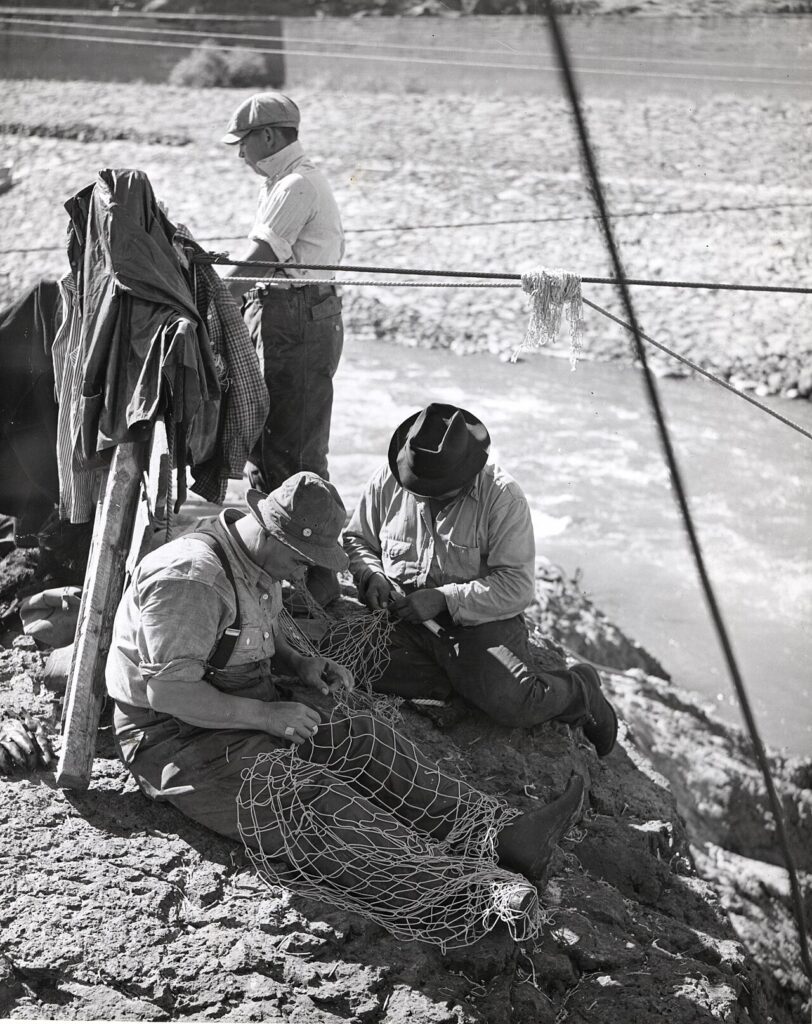
Native salmon fishermen repair their nets at Celilo Falls, Oregon, circa 1950. This earlier Columbia River photograph illustrates the work behind fishing-rights disputes; it does not depict a Washington fish-in or the Boldt proceedings. Credit: NOAA Historic Fisheries Collection, fish5711; photographer uncredited. Original source. Public domain: NOAA photograph, Commons PD-US-NOAA record.
WASHINGTON STATE, March 8.—Native fishing families and their supporters are bringing a dispute over treaty rights directly to the rivers where those rights must be exercised. The fish-ins challenge restrictions enforced by the state and insist that the treaties be treated as continuing commitments.
The demonstrations draw on the example of civil-rights sit-ins, but the demand has a particular legal foundation. The tribes contend that access to their accustomed fisheries was reserved in treaties with the United States. They are asking that those commitments be honored in the places where fishing supplies food and income.
Hank Adams and organizers associated with the Survival of American Indians Association have helped bring attention to the struggle. Young Native activists have joined the effort, connecting the defense of fishing families with a wider discussion of self-determination.
Arrests make a photograph and a brief report. The underlying dispute requires more explanation: the wording of the treaties, the history of the fisheries, the state’s claimed authority and the consequences of enforcement for people whose livelihood depends on access to the water.
Conservation cannot be treated casually by anyone who depends upon a fishery. The contested question is how regulation is imposed and whether it respects rights the federal government promised to protect. A demand for compliance with a treaty is not answered simply by calling it a request for special treatment.
The outcome is unsettled. Each return to the river makes the distance between a written promise and an enforced restriction visible. Southern California tribes have different treaties and legal histories, but the insistence that public authority account for its obligations has a wider resonance.
Explore the Story
Sources & further reading.
Related Herald reporting
- Section 14 Places Palm Springs’ Growth Beside the Cost of Displacement — Thomas Navarro, 1966-12-18.
- Voting Rights Act Gives Federal Force to the Fight Against Racial Exclusion — Thomas Navarro, 1965-08-07.
- California Indian Legal Services Builds a Practice Around Tribal Rights — Thomas Navarro, 1967-12-17.
- A Younger Generation Organizes to Speak for Itself — Thomas Navarro, 1961-09-03.
- Native Delegates Bring Treaties and Sovereignty to the Poor People’s Campaign — Thomas Navarro, 1968-06-20.
- American Indian Movement Begins With the Needs of Native City Residents — Thomas Navarro, 1968-12-22.
- Alcatraz Occupation Ends; the Questions It Raised Remain on the Mainland — Thomas Navarro, 1971-06-12.
- Trail of Broken Treaties Brings Twenty Demands Into Washington — Katherine “Kate” Romero, 1972-11-10.
- Wounded Knee Occupation Ends After Seventy-One Days — Katherine “Kate” Romero, 1973-05-09.
- Court Affirms Treaty Tribes’ Share of Washington Fisheries — Katherine “Kate” Romero, 1974-02-13.
- Longest Walk Reaches Washington With Treaty Rights at Its Center — Katherine “Kate” Romero, 1978-07-23.
- Tribal Delegates Form a National Congress to Defend Their Rights — Edward Hensley, 1944-11-19.
- Inspectors get a framework for checking the nuclear treaty’s promises — Sharon Russell, 1971-04-20.

Join the conversation