

The Aeon Herald / HISTORICAL EDITION
A Younger Generation Organizes to Speak for Itself
The National Indian Youth Council takes shape after a Gallup meeting, bringing young Native organizers into a growing national conversation.
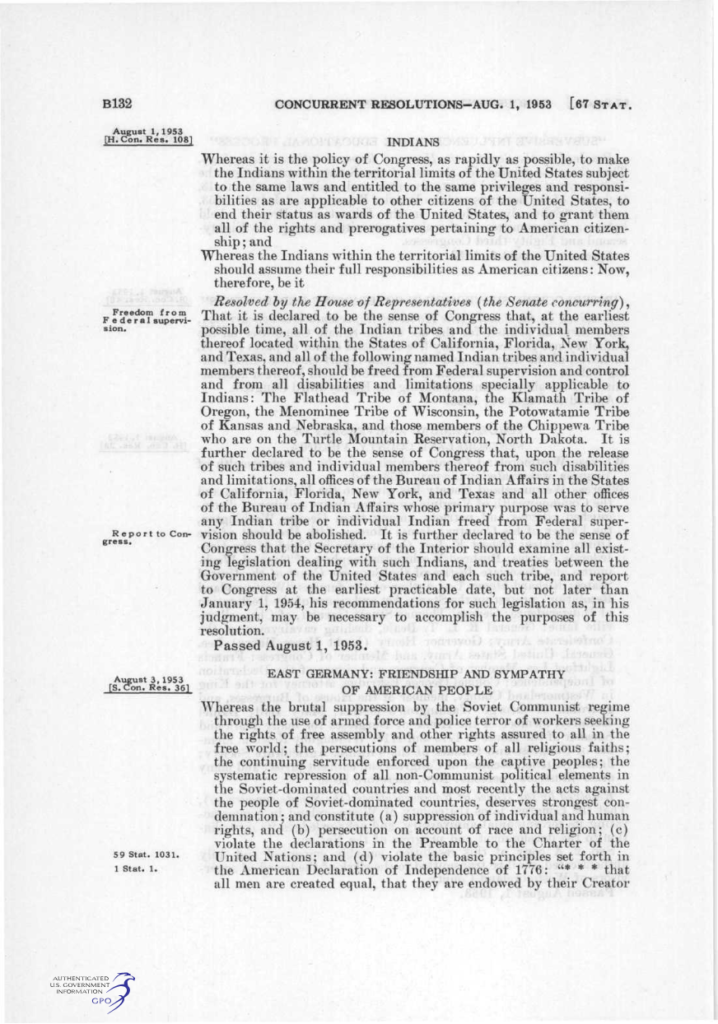
House Concurrent Resolution 108, August 1, 1953, reproduced from the U.S. Statutes at Large. The termination policy formed part of the political setting facing the new youth council; its founding meeting is not pictured. Credit: U.S. Congress / Government Publishing Office, GovInfo. Original source. Public domain: official U.S. federal government publication and statutory text. Public domain.
GALLUP, N.M., Sept. 3.—Young Indian organizers have begun building a national council of their own, carrying the discussions of student workshops and this summer’s American Indian Chicago Conference into a continuing organization. The National Indian Youth Council’s first meeting took place here August 10.
The council gives younger people a means of working across tribal and campus boundaries. Its formation does not mean that Native political activity has suddenly begun. Tribal governments and national organizations already have long records of petitioning and negotiation. The development is a new organization through which young people intend to make their own judgments heard.
Mel Thom and Clyde Warrior are among the young leaders associated with the effort. Shirley Hill Witt’s involvement also makes clear that its intellectual and organizational work includes women. The council will need to connect the ambitions expressed at meetings with sustained work in the communities its members know.
The federal policy of termination gives those discussions an immediate setting. Questions about education and employment lead back to land and government: who makes a decision, whose interests it serves, and whether an Indian community is permitted to determine its own future.
For a Southern California reader, Gallup is closer than a map alone suggests. Students and workers move between reservations, cities and colleges; news of one organization can travel through those relationships. The political discussion is taking place in letters and small meetings as well as public addresses.
The test ahead is organization. A council must circulate information, maintain contact and decide how to act when its members disagree. Its founding has opened a place for a younger voice. The work of giving that voice continuity now begins.
Explore the Story
Sources & further reading.
Related Herald reporting
- California Rancheria Law Sets Conditions for Ending Federal Trust Relations — Joan Mercer, 1958-08-19.
- Section 14 Places Palm Springs’ Growth Beside the Cost of Displacement — Thomas Navarro, 1966-12-18.
- Fishing Families Put Treaty Promises on the Riverbank — Thomas Navarro, 1964-03-08.
- Native Delegates Bring Treaties and Sovereignty to the Poor People’s Campaign — Thomas Navarro, 1968-06-20.
- American Indian Movement Begins With the Needs of Native City Residents — Thomas Navarro, 1968-12-22.
- Alcatraz Occupation Ends; the Questions It Raised Remain on the Mainland — Thomas Navarro, 1971-06-12.
- Trail of Broken Treaties Brings Twenty Demands Into Washington — Katherine “Kate” Romero, 1972-11-10.
- Wounded Knee Occupation Ends After Seventy-One Days — Katherine “Kate” Romero, 1973-05-09.
- Court Affirms Treaty Tribes’ Share of Washington Fisheries — Katherine “Kate” Romero, 1974-02-13.
- Tribal Delegates Form a National Congress to Defend Their Rights — Edward Hensley, 1944-11-19.
- Longest Walk Reaches Washington With Treaty Rights at Its Center — Katherine “Kate” Romero, 1978-07-23.
- The Federal Relocation Promise Meets the Cost of Living in Los Angeles — Lillian Marsh, 1956-08-12.

Join the conversation