

The Aeon Herald / HISTORICAL EDITION
Indian Health Council Begins With Local Work and a Claim to Better Care
North County tribal organizers establish an incorporated health council and begin building services around reservation communities.
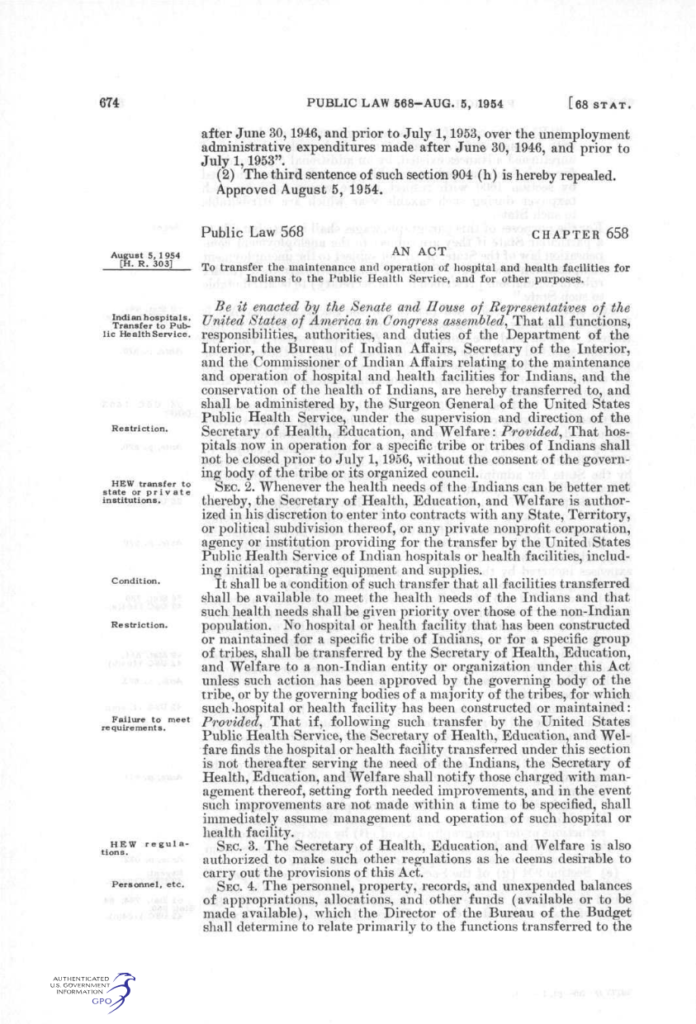
Facsimile from the Indian health transfer act, August 5, 1954, reproduced from the U.S. Statutes at Large. The original statutory page is shown without alteration. Credit: U.S. Congress / Government Publishing Office, GovInfo. Original source. Public domain: official U.S. federal government publication and statutory text. Public domain.
SAN DIEGO COUNTY, Dec. 20.—A small health undertaking in the county’s northern reservations has acquired a continuing institutional form this year. Indian Health Council was incorporated January 19, carrying forward work begun through a rural Indian health demonstration project.
The earlier effort connected residents with medical and dental services through information, appointments, referrals and transportation. Its experience made clear that the existence of a doctor somewhere in the county was not the same as practical access to care.
Dennis Magee and other local organizers have worked to keep the undertaking alive through uncertain funding. Incorporation places responsibility in an organization whose purpose is tied to the communities it serves, rather than leaving each household to negotiate the distance between a reservation and an outside office.
Dental care is among the immediate concerns. A modest building on the Rincon reservation has been made available for a clinic, with contributions of money, materials and labor. Volunteer professional work helps turn those contributions into treatment.
There is little ceremony in arranging a ride or finding supplies. Yet those tasks determine whether a person receives care. Their importance is easily missed when Indian affairs are reported only through a confrontation with Washington.
The council’s beginning belongs to the same larger demand for a voice in public decisions. Its work asks a practical question: can Native communities help shape the services on which their health depends? The answer will be found in reliable staffing, adequate resources and care that people can actually reach.
Explore the Story
Sources & further reading.
Related Herald reporting
- Blue Lake Return Gives Land to a Policy of Self-Determination — Thomas Navarro, 1970-12-16.
- San Diego Tribal Chairmen Establish a Common Working Association — Katherine “Kate” Romero, 1972-12-10.
- Trail of Broken Treaties Brings Twenty Demands Into Washington — Katherine “Kate” Romero, 1972-11-10.
- On Winston Street, Native Women Build a Place to Turn — Katherine “Kate” Romero, 1974-12-15.
- Federal Review Finds Serious Failures in Sterilization Consent Procedures — Katherine “Kate” Romero, 1976-11-07.
- Rincon Clinic Opening Marks Years of Work Toward Native-Directed Care — Katherine “Kate” Romero, 1976-12-12.
- Women of All Red Nations Connect Health, Family and Political Survival — Katherine “Kate” Romero, 1978-12-10.
- San Diego’s Native Community Establishes an Urban Health Center — Katherine “Kate” Romero, 1979-12-09.
- Alcatraz Occupation Ends; the Questions It Raised Remain on the Mainland — Thomas Navarro, 1971-06-12.
Join the conversation