The Aeon Herald / HISTORICAL EDITION
An Erratically Dimming Star Draws a Search for Natural—and Artificial—Causes
Unusual losses of light from KIC 8462852 make it a difficult astrophysical puzzle and a proposed SETI target.
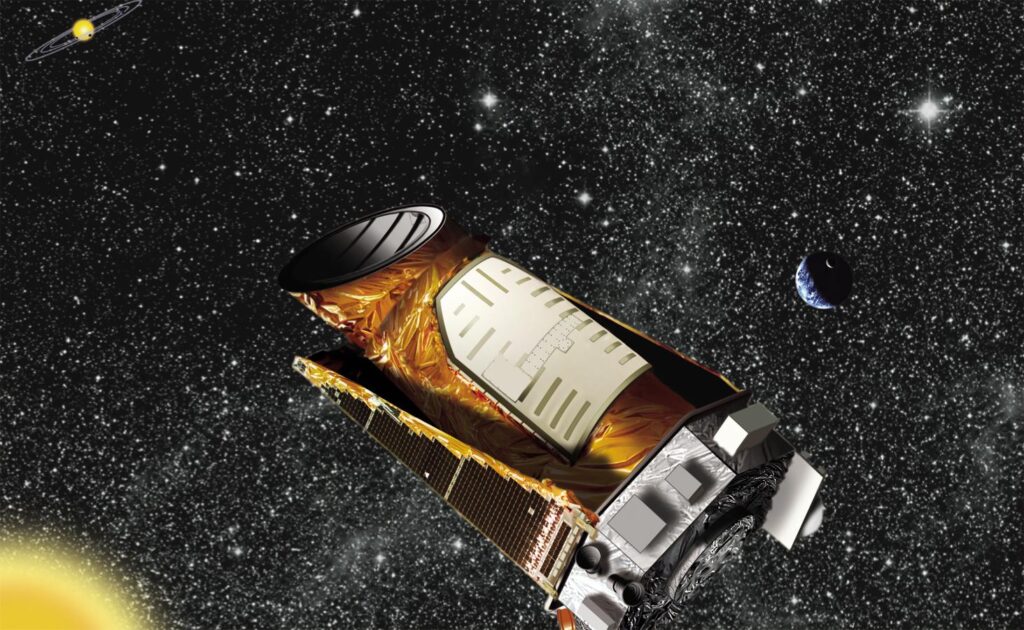
A star recorded by NASA’s Kepler telescope has shown dimming unlike the tidy signature of an ordinary transiting planet. KIC 8462852 underwent irregular dips that at their deepest exceeded 20 percent of its measured light, prompting competing explanations involving material around the star and a proposal to examine it for signs of technology.
Tabetha Boyajian and colleagues describe the observations in a research preprint released last month. Their checks argue that the changes are astrophysical rather than a processing error. The star otherwise appears to be a main-sequence F-type object, and its infrared measurements do not show the substantial excess expected from some arrangements of warm surrounding dust.
The discovery team favors a family of comet or planetesimal fragments as the best match among the scenarios it examines. Such material could cross the line of sight in irregular groups. The proposal still has to account for the depth, timing and shape of the observed losses of light.
A separate paper by Jason T. Wright and colleagues considers how artificial structures crossing a star might appear in telescope data. It identifies this object as a promising target for the search for extraterrestrial intelligence. In that discussion, a swarm of structures is a hypothesis about the light curve, not a resolved image of construction around the star.
Kepler measures brightness over time. Its planet discoveries demonstrate how a small dip can reveal an otherwise unseen object, but an unusual dip does not uniquely determine the object’s composition or origin. Dust, fragments and artificial silhouettes must be distinguished by further measurements.
The immediate scientific opportunity is therefore specific: watch for additional dimming, compare observations across wavelengths, and look for evidence that can separate the proposed causes. Catching another dip with several instruments would help test whether the obscuring material behaves like dust, fragments or another kind of object.
Sources & further reading
- Planet Hunters X. KIC 8462852 — Where’s the Flux? — T. S. Boyajian and colleagues / research preprint; September 11, 2015, version 1.
- The Ĝ Search for Extraterrestrial Civilizations with Large Energy Supplies. IV. The Signatures and Information Content of Transiting Megastructures — Jason T. Wright, Kimberly M. S. Cartier, Ming Zhao, Daniel Jontof-Hutter and Eric B. Ford / research preprint; October 15, 2015, version 1.
- Kepler’s Six Years in Science (and Counting) — NASA / Kepler mission; May 11, 2015.
Related Herald reporting
- A Star Seen Through Saturn’s Rings Reveals Waves and Narrow Gaps — Paul Norton, 1982-01-30.
- A More Sensitive Search Leaves the Wow! Signal Unanswered — Adrian Mercer, 2001-01-12.
- Another Dimming Star Comes With a Disk—and a Different Puzzle — Eric Bennett, 2016-08-27.
- A Claim of Signals in 234 Stars Faces an Independent Test — Eric Bennett, 2016-10-12.
- Seven Dyson Sphere Candidates Face a Test of What Lies Behind Them — Sarah Nguyen, 2024-05-24.
- A Giant Star Nearly Vanishes Behind an Unseen Obscurer — Sarah Nguyen, 2021-06-12.