The Aeon Herald / HISTORICAL EDITION
A More Sensitive Search Leaves the Wow! Signal Unanswered
A Very Large Array investigation narrows possible explanations for the 1977 radio event without identifying its source.
A new search of the sky positions associated with the Wow! signal has failed to recover the narrowband emission that made an Ohio radio observation famous in 1977. The result rules against some explanations involving a normally faint, continuous source, while leaving the original event without an established cause.
Robert H. Gray and Kevin B. Marvel report the observations in the January 10 Astrophysical Journal. Using the Very Large Array in New Mexico, they looked with substantially greater sensitivity than the original Ohio State survey. Two ordinary radio sources appeared in the relevant areas, but neither had the unusual spectral features or variability needed to explain the earlier detection.
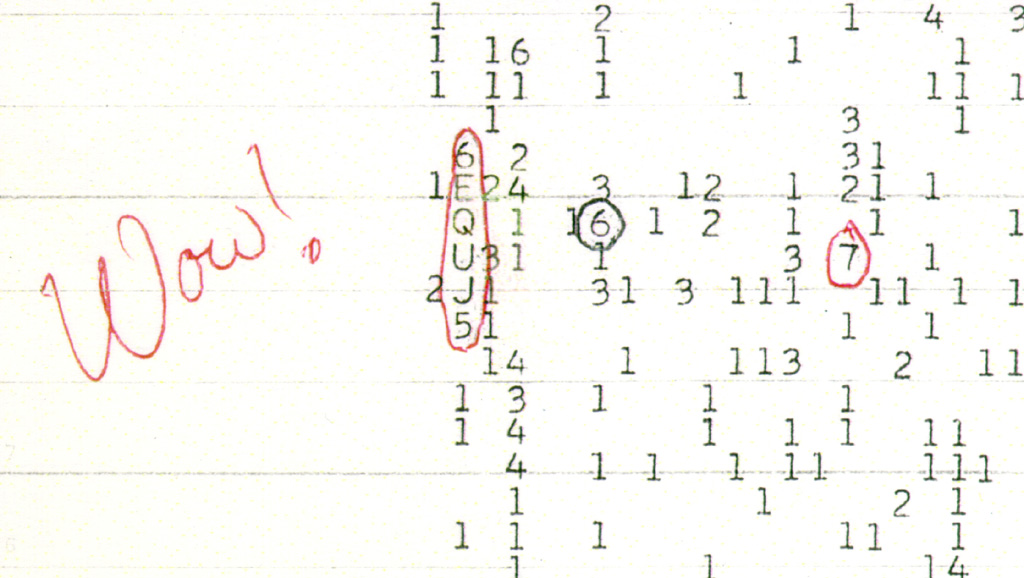
The original observation arrived at the Big Ear telescope on August 15, 1977. Jerry Ehman later noticed six conspicuous intensity readings on a computer printout and marked them with the exclamation that supplied the event’s name. The sequence 6EQUJ5 records changing signal strength; it is not a decoded message.
The emission occupied a narrow frequency channel near the hydrogen line and followed a rise and fall consistent with a source passing through the telescope’s beam. It was recorded in only one of the instrument’s two beams. That combination has kept both a celestial source and interference in the discussion.
The new search has an important limit. Observations lasting minutes at each position cannot adequately test a source that turns on only occasionally. The absence of another detection therefore constrains particular physical explanations without demonstrating that no intermittent source exists.
A confirmed repetition would permit measurements that the printout alone cannot supply. For now, the record consists of one striking observation, careful examinations of the equipment and sky, and a growing set of limits on what could have produced it.
Sources & further reading
- A VLA Search for the Ohio State “Wow” — Robert H. Gray and Kevin B. Marvel / The Astrophysical Journal; January 10, 2001.
- The Big Ear Wow! Signal: What We Know and Don’t Know About It After 20 Years — Jerry R. Ehman / Ohio State University Radio Observatory; September 1, 1997; revised February 3, 1998.
Related Herald reporting
- Soviet Satellite Circles Earth; Radio Signal Heard — Paul Norton, 1957-10-05.
- An Erratically Dimming Star Draws a Search for Natural—and Artificial—Causes — Eric Bennett, 2015-10-20.
- Another Dimming Star Comes With a Disk—and a Different Puzzle — Eric Bennett, 2016-08-27.
- A Claim of Signals in 234 Stars Faces an Independent Test — Eric Bennett, 2016-10-12.
- Seven Dyson Sphere Candidates Face a Test of What Lies Behind Them — Sarah Nguyen, 2024-05-24.
- A Millisecond Radio Flash Opens a Question in the Distant Universe — Adrian Mercer, 2007-09-29.
- The Radio Burst That Came Back Challenges One-Time Explanations — Sarah Nguyen, 2016-03-03.
- The Proxima Signal Leads Investigators Back to Earth — Sarah Nguyen, 2021-10-26.