

The Aeon Herald / HISTORICAL EDITION
Indian Voters Win Court Rulings in Arizona and New Mexico
Successful challenges to reservation-based exclusions expose the distance between American citizenship and access to the ballot.
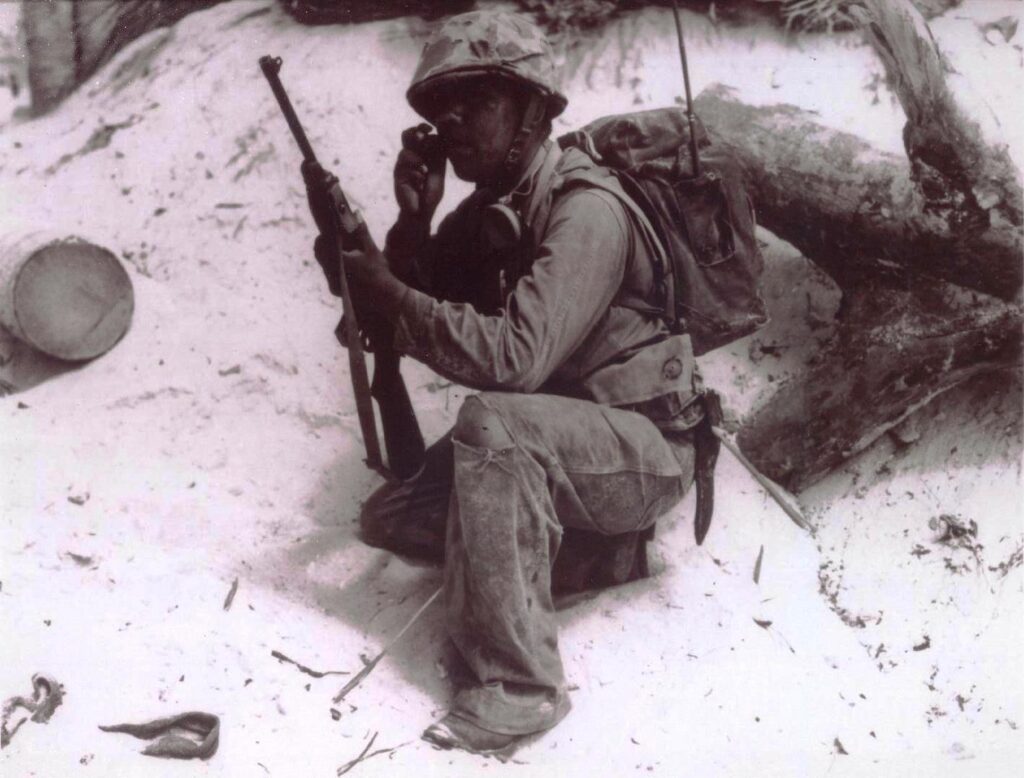
A Navajo Marine radio operator on Tarawa in November 1943. A wartime service photograph; the operator is not identified in the collection record. Credit: Official U.S. Marine Corps photograph / USMC Archives. Original source. CC BY 2.0, as released by USMC Archives; unaltered apart from web sizing. CC BY 2.0.
SANTA FE, Aug. 8.—Court challenges in New Mexico and Arizona have struck at restrictions that kept Native citizens from voting because of their reservation status. The decisions give practical force to a question the states have long avoided: whether citizenship can be acknowledged while its most familiar political right is withheld.
In Arizona, Frank Harrison and Harry Austin challenged exclusion from registration. The state Supreme Court ruled in July that reservation residence did not place otherwise qualified Indian citizens under the sort of legal guardianship that would disqualify them from voting.
In New Mexico, Miguel Trujillo, an Isleta Pueblo veteran, challenged the state’s exclusion of Indians described as not taxed. The federal court found the distinction constitutionally impermissible. Military service made the denial particularly stark, but the right asserted does not depend on having worn a uniform.
The two proceedings concern different state provisions. They share the refusal to accept a broad administrative description of Indian people as a lawful substitute for examining the qualifications of an individual voter.
A favorable judgment does not complete registration, provide transportation to a polling place or end intimidation. County officials must carry out the decisions. Citizens must be able to register and vote without being told that participation will forfeit their tribal homes or relationships.
The importance of these rulings reaches into Southern California, where Native families maintain ties across the Southwest. The ballot and tribal citizenship need not cancel one another. The courts have required the states to confront the rights of people who possess both.
Explore the Story
Sources & further reading.
Related Herald reporting
- Indian Claims Commission Opens a Federal Hearing for Old Wrongs — Samuel Voss, 1946-08-14.
- Congress Announces a Policy of Ending Federal Supervision of Indian Tribes — Edward Hensley, 1953-08-02.
- New Law Extends California’s Court Jurisdiction Into Indian Country — William Keane, 1953-08-16.
- Supreme Court Rules School Segregation Unconstitutional — Mary Ellison, 1954-05-18.
- Montgomery Buses Desegregated as Boycott Ends — Thomas McKenna, 1956-12-22.
- Marchers Fill Washington With Demand for Jobs and Freedom — Richard Salazar, 1963-08-29.
- Johnson Signs Civil Rights Act After Long Congressional Fight — Thomas McKenna, 1964-07-03.
- Voting Rights Act Gives Federal Force to the Fight Against Racial Exclusion — Thomas Navarro, 1965-08-07.
- Rosa Parks Dies at 92; Her Resistance Reached Beyond One Bus Ride — Monica Grant, 2005-10-25.
- Native Servicemen Return to a Country Still Being Asked to Keep Its Promises — William Keane, 1945-11-11.
Join the conversation