

The Aeon Herald / HISTORICAL EDITION
Indian Claims Commission Opens a Federal Hearing for Old Wrongs
A new commission can hear tribal claims against the United States, including claims that previously lacked a practical legal forum.
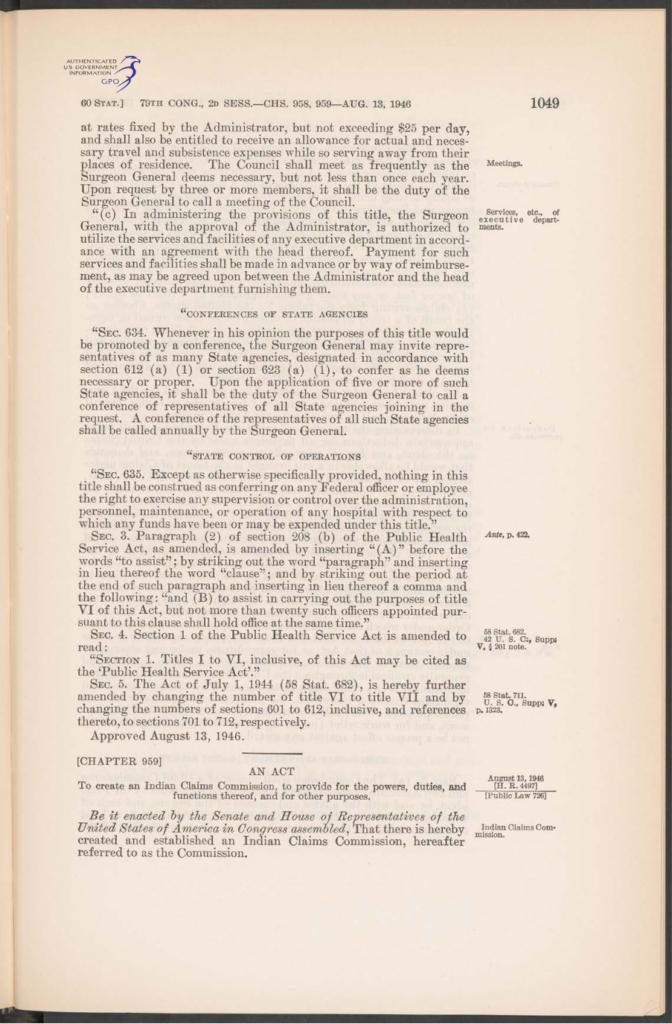
Facsimile from the Indian Claims Commission Act, August 13, 1946, reproduced from the U.S. Statutes at Large. The original statutory page is shown without alteration. Credit: U.S. Congress / Government Publishing Office, GovInfo. Original source. Public domain: official U.S. federal government publication and statutory text. Public domain.
WASHINGTON, Aug. 14.—President Truman yesterday approved a law establishing an Indian Claims Commission to hear claims against the United States. The new body gives tribes and other eligible Indian groups a forum for demands arising from federal dealings that have often remained unresolved for generations.
The commission’s authority includes claims based on treaties and laws, as well as certain claims concerning unfair dealings and compensation for land. Congress has provided a period in which eligible claims must be presented. The task of assembling records will therefore be immediate, even where the transactions themselves are old.
Treaty texts, survey descriptions, payment records and the circumstances of a land transfer may become important evidence. For a community, the underlying matter may be remembered through a lost place or an obligation that was never fulfilled. A legal proceeding must connect those experiences with the standards Congress has established.
The remedy is framed in terms of claims and monetary awards. A payment is not the same thing as the return of a homeland. That distinction should remain clear whenever a settlement is described as a final answer to a history of dispossession.
Nor does the creation of a commission mean that the government has admitted every allegation brought before it. Claims will require hearings and decisions. The law supplies a procedure through which those questions can be examined instead of remaining outside the courthouse.
For California Indian communities, the opportunity also brings demanding work: locating documents, securing counsel and determining precisely what is claimed. The commission should be judged by the fairness of that process and the treatment of the people seeking a hearing.
Explore the Story
Sources & further reading.
Related Herald reporting
- Native Servicemen Return to a Country Still Being Asked to Keep Its Promises — William Keane, 1945-11-11.
- Indian Voters Win Court Rulings in Arizona and New Mexico — Samuel Voss, 1948-08-08.
- Congress Announces a Policy of Ending Federal Supervision of Indian Tribes — Edward Hensley, 1953-08-02.
- Tribal Delegates Form a National Congress to Defend Their Rights — Edward Hensley, 1944-11-19.
Join the conversation