

The Aeon Herald / HISTORICAL EDITION
Tribal Delegates Form a National Congress to Defend Their Rights
Delegates meeting in Denver establish the National Congress of American Indians, joining distinct tribal interests in a national political organization.
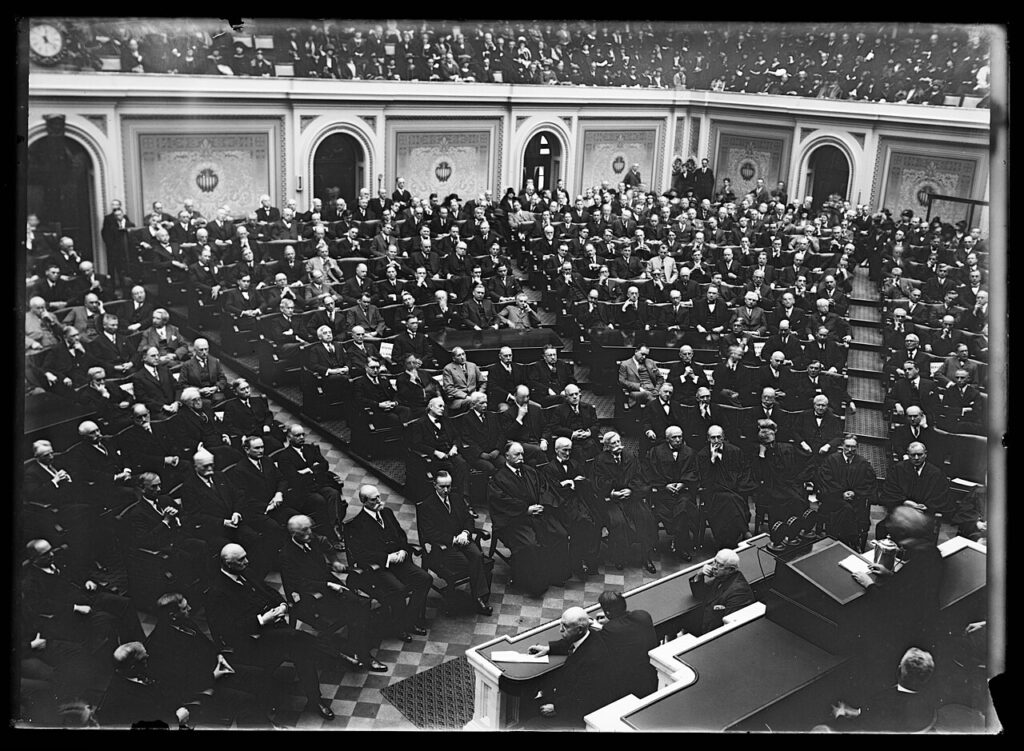
The U.S. Capitol in 1923. Earlier institutional context for the federal decisions and treaty obligations discussed in this report; the reported meeting or demonstration is not pictured. Credit: Harris & Ewing Collection / Library of Congress. Original source. Public domain: Harris & Ewing collection; Library of Congress reports no known restrictions.
DENVER, Nov. 19.—Delegates from Indian tribes and associations have established the National Congress of American Indians, creating an organization intended to give their concerns a stronger hearing before the public and the federal government. Nearly eighty delegates representing fifty tribes and associations in twenty-seven states took part in the founding meeting.
The gathering began November 15 at the Cosmopolitan Hotel. Its constitution sets out work concerning treaty rights, tribal affairs, cultural values and public understanding. The program brings together questions often treated separately in Washington: land and law, the conduct of administration, and the survival of communities as communities.
The new congress does not erase the separate governments or circumstances of its members. Cooperation has another purpose: to bring shared problems before a national audience and to resist decisions made without adequate Indian participation.
The country is still at war, and Indian service is part of that national effort. The organization’s formation also directs attention toward the terms of the peace at home. Decisions concerning land, employment and government will affect returning servicemen and the families who have sustained them.
A standing organization can collect information, present arguments and answer proposals before they become settled policy. Its influence will depend on the continuing work of delegates as much as on the statement adopted at their first meeting.
For readers in Southern California, the Denver meeting creates a national development worth following alongside the affairs of each local reservation. A common platform may carry matters farther; it does not relieve a newspaper of learning the particular facts of each community.
Explore the Story
Sources & further reading.
Related Herald reporting
- New Indian Law Halts Allotment and Opens a Different Course for Tribal Government — Samuel Voss, 1934-06-19.
- Native Servicemen Return to a Country Still Being Asked to Keep Its Promises — William Keane, 1945-11-11.
- Indian Claims Commission Opens a Federal Hearing for Old Wrongs — Samuel Voss, 1946-08-14.
- A Younger Generation Organizes to Speak for Itself — Thomas Navarro, 1961-09-03.
- Fishing Families Put Treaty Promises on the Riverbank — Thomas Navarro, 1964-03-08.
- Native Delegates Bring Treaties and Sovereignty to the Poor People’s Campaign — Thomas Navarro, 1968-06-20.
- American Indian Movement Begins With the Needs of Native City Residents — Thomas Navarro, 1968-12-22.
- Alcatraz Occupation Ends; the Questions It Raised Remain on the Mainland — Thomas Navarro, 1971-06-12.
- Trail of Broken Treaties Brings Twenty Demands Into Washington — Katherine “Kate” Romero, 1972-11-10.
- Wounded Knee Occupation Ends After Seventy-One Days — Katherine “Kate” Romero, 1973-05-09.
- Court Affirms Treaty Tribes’ Share of Washington Fisheries — Katherine “Kate” Romero, 1974-02-13.
- Longest Walk Reaches Washington With Treaty Rights at Its Center — Katherine “Kate” Romero, 1978-07-23.
- A City’s Water Project Sends Kumeyaay Families Toward a New Home — Henry Pritchard, 1932-12-31.
- At Sherman Institute, Schooling Reaches Into the Life of the Family — Beatrice Lyle, 1933-11-19.
Join the conversation