

The Aeon Herald / HISTORICAL EDITION
Indian Civil Rights Act Sets Individual Protections Within Tribal Government
Title II of the new civil-rights law specifies rights while raising questions about federal power and tribal self-government.
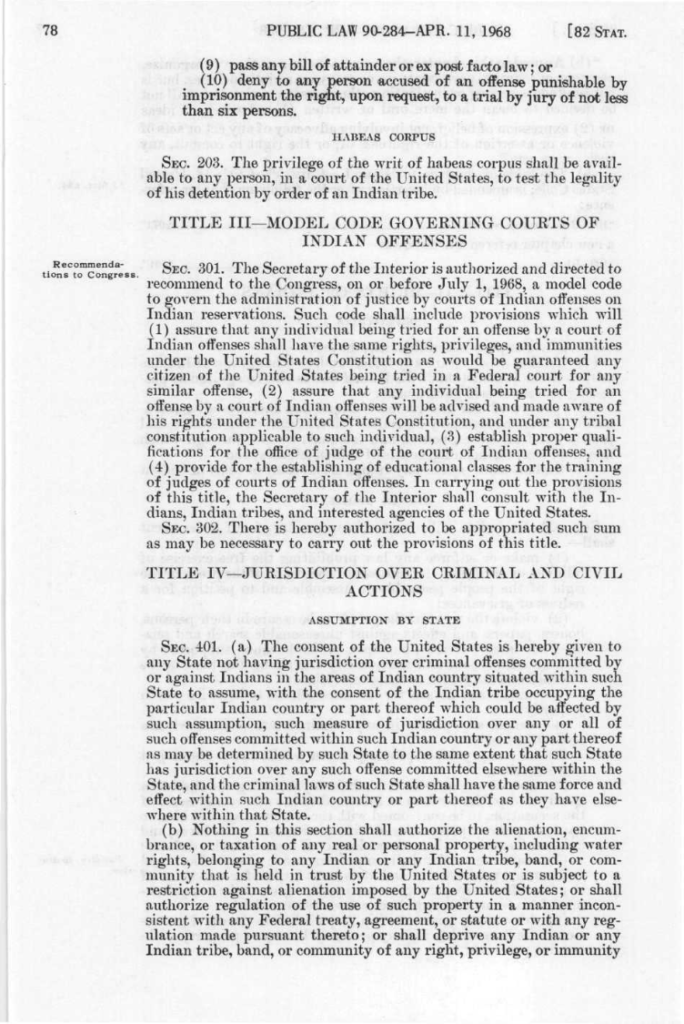
Facsimile from the Title II of the Civil Rights Act, April 11, 1968, reproduced from the U.S. Statutes at Large (PDF page 6). The original statutory page is shown without alteration. Credit: U.S. Congress / Government Publishing Office, GovInfo. Original source. Public domain: official U.S. federal government publication and statutory text. Public domain.
WASHINGTON, Apr. 12.—The civil-rights legislation signed yesterday includes an Indian Civil Rights Act setting out protections that tribal governments must observe in exercising powers of self-government. Its provisions bring individual rights and the authority of Native governments into a consequential new statutory relationship.
The act protects religious exercise, speech, press and peaceful assembly, and addresses unreasonable searches, self-incrimination, double jeopardy and deprivation of property without compensation. It also specifies criminal-procedure protections and prohibits denial of equal protection or due process.
These are particular provisions enacted by Congress. The law does not simply apply the entire federal Bill of Rights to tribes. One practical distinction concerns counsel: the act provides for assistance at the defendant’s own expense, rather than a general promise of a publicly appointed lawyer.
The statute limits the punishment a tribal court may impose for one offense to six months’ imprisonment, a five-hundred-dollar fine, or both. It also permits a person detained by tribal order to seek habeas corpus in a United States court. Those terms should be reported as the law now enacted, with attention to the institutions expected to carry them out.
Support for individual protections does not remove the question of who has authority to prescribe a tribe’s governmental arrangements. Native nations have their own histories and responsibilities. Congress’s intervention will be considered in that setting as well as through familiar constitutional language.
The first task is accurate explanation. Citizens need to know what the statute says, what it omits and where a claim may be heard. Neither a broad celebration of new rights nor a broad dismissal of tribal concerns can substitute for reading the measure.
Explore the Story
Sources & further reading.
Related Herald reporting
- California Indian Legal Services Builds a Practice Around Tribal Rights — Thomas Navarro, 1967-12-17.
- American Indian Movement Begins With the Needs of Native City Residents — Thomas Navarro, 1968-12-22.
- Native Delegates Bring Treaties and Sovereignty to the Poor People’s Campaign — Thomas Navarro, 1968-06-20.
- Section 14 Places Palm Springs’ Growth Beside the Cost of Displacement — Thomas Navarro, 1966-12-18.
- Blue Lake Return Gives Land to a Policy of Self-Determination — Thomas Navarro, 1970-12-16.
- Rincon Appeal Ends on a Jurisdiction Question, Leaving County Authority Unsettled — Katherine “Kate” Romero, 1974-06-16.
- New Law Offers Tribes a Greater Role in Running Federal Programs — Katherine “Kate” Romero, 1975-01-05.
- Agua Caliente’s Women Leaders Press for Control of Their Land’s Future — William Keane, 1959-12-13.
- California Rancheria Law Sets Conditions for Ending Federal Trust Relations — Joan Mercer, 1958-08-19.
- New Law Extends California’s Court Jurisdiction Into Indian Country — William Keane, 1953-08-16.
- Congress Announces a Policy of Ending Federal Supervision of Indian Tribes — Edward Hensley, 1953-08-02.
- New Indian Law Halts Allotment and Opens a Different Course for Tribal Government — Samuel Voss, 1934-06-19.
- Voting Rights Act Gives Federal Force to the Fight Against Racial Exclusion — Thomas Navarro, 1965-08-07.
- Indian Child Welfare Act Sets Standards Against the Breakup of Native Families — Katherine “Kate” Romero, 1978-11-09.

Join the conversation