

The Aeon Herald / HISTORICAL EDITION
Native Delegates Bring Treaties and Sovereignty to the Poor People’s Campaign
Martha Grass’s Solidarity Day address places Native poverty within a wider civil-rights coalition while insisting on its particular history.
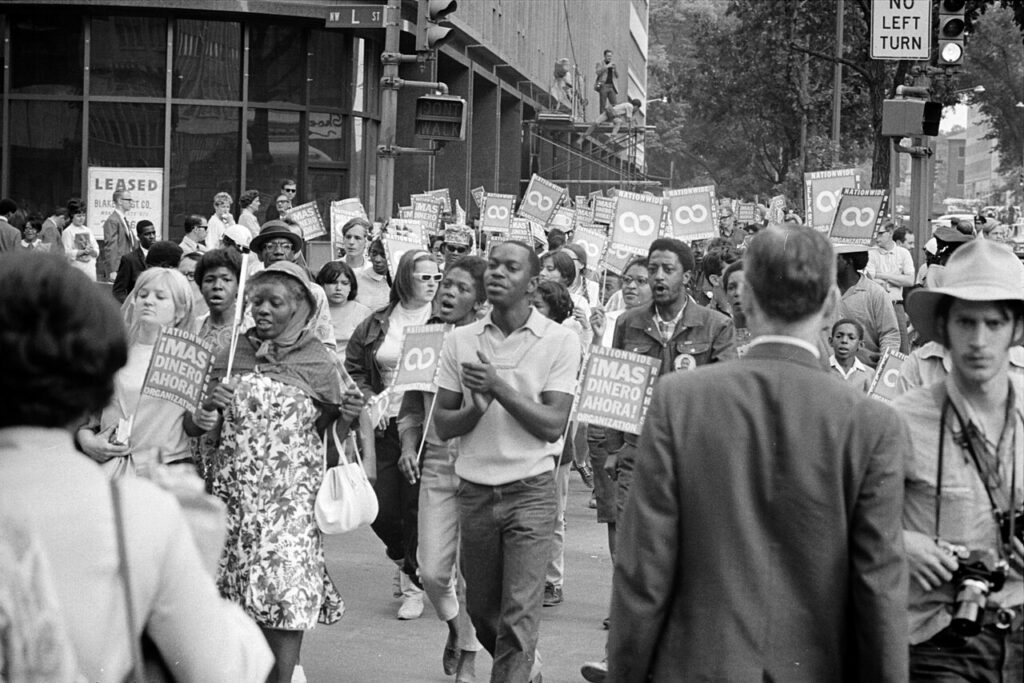
Poor People’s Campaign demonstrators at Lafayette Park and Connecticut Avenue, Washington, June 18, 1968. The photograph shows the broader campaign, without identifying particular marchers as Native delegates. Credit: Warren K. Leffler / U.S. News & World Report Collection, Library of Congress. Original source. Public domain: U.S. News & World Report collection donation; no known restrictions on publication.
WASHINGTON, June 20.—Native participants in the Poor People’s Campaign have brought the government’s treaty obligations before a national coalition demanding economic justice. At yesterday’s Solidarity Day gathering, Martha Grass, a Ponca mother from Oklahoma, directed attention to the conditions faced by Indian families and to the promises behind them.
The campaign, planned by the late Dr. Martin Luther King Jr. and carried forward after his assassination, has brought people of different backgrounds to Washington. Its Resurrection City encampment has made poverty visible near the institutions empowered to address it.
Native delegates have participated in the campaign’s work before Congress and federal agencies. Tillie Walker, Mel Thom and Hank Adams have been among those advancing Indian concerns. Their demands connect material conditions with decisions over land, resources and government.
That connection gives the coalition a demanding task. People may share poor housing or inadequate wages while arriving at those circumstances through different histories. For a Native nation, poverty may also reflect the loss of land or restrictions on the use of resources it retains.
The demand for self-determination therefore belongs within the economic discussion. Better services are necessary, but communities also seek authority over the decisions that shape their lives. A federal program that leaves that authority untouched may fail to answer an important part of the complaint.
Yesterday’s address put those matters before a broad audience. The work after the rally will be to follow the petitions into the agencies and committees receiving them. A coalition’s visibility matters most when officials must answer the specific obligations its participants have brought forward.
Explore the Story
Sources & further reading.
Related Herald reporting
- American Indian Movement Begins With the Needs of Native City Residents — Thomas Navarro, 1968-12-22.
- Native Students Press UCLA to Make Their History Part of the University — Thomas Navarro, 1969-12-07.
- Alcatraz Occupation Ends; the Questions It Raised Remain on the Mainland — Thomas Navarro, 1971-06-12.
- Fishing Families Put Treaty Promises on the Riverbank — Thomas Navarro, 1964-03-08.
- Trail of Broken Treaties Brings Twenty Demands Into Washington — Katherine “Kate” Romero, 1972-11-10.
- Wounded Knee Occupation Ends After Seventy-One Days — Katherine “Kate” Romero, 1973-05-09.
- Court Affirms Treaty Tribes’ Share of Washington Fisheries — Katherine “Kate” Romero, 1974-02-13.
- A Younger Generation Organizes to Speak for Itself — Thomas Navarro, 1961-09-03.
- Longest Walk Reaches Washington With Treaty Rights at Its Center — Katherine “Kate” Romero, 1978-07-23.
- Tribal Delegates Form a National Congress to Defend Their Rights — Edward Hensley, 1944-11-19.
- Indian Civil Rights Act Sets Individual Protections Within Tribal Government — Thomas Navarro, 1968-04-12.
Join the conversation