

The Aeon Herald / HISTORICAL EDITION
Congress Recognizes a Federal Duty to Protect Native Religious Practice
The American Indian Religious Freedom Act addresses ceremonies, sacred objects and access to sites, with implementation still ahead.
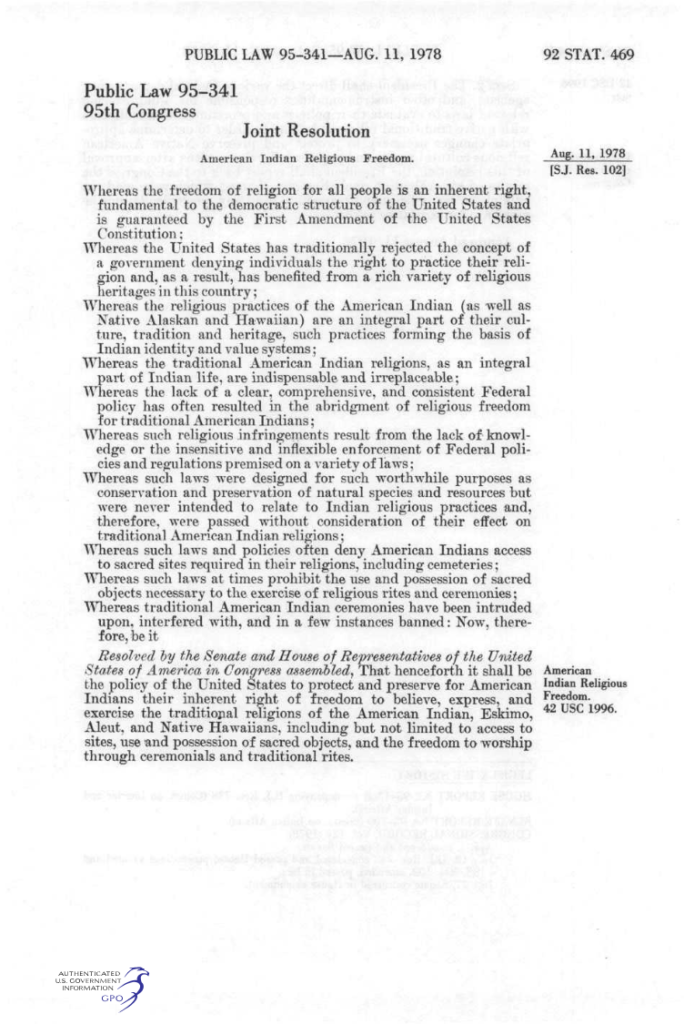
Facsimile from the American Indian Religious Freedom Act, August 11, 1978, reproduced from the U.S. Statutes at Large. The original statutory page is shown without alteration. Credit: U.S. Congress / Government Publishing Office, GovInfo. Original source. Public domain: official U.S. federal government publication and statutory text. Public domain.
WASHINGTON, Aug. 13.—A joint resolution signed Friday declares federal policy to protect and preserve the freedom of Native people to practice their traditional religions. The American Indian Religious Freedom Act addresses belief and worship together with access to sites and the use and possession of sacred objects.
The resolution recognizes that government action has restricted religious life in ways not adequately understood by officials administering general laws and public lands. A ceremony may depend on a particular place or object. A broad assurance of freedom can have little practical meaning if access to that place is denied.
The measure calls for federal agencies to evaluate their policies and procedures in consultation with Native religious leaders and to report recommendations. That work places responsibility on the government to examine how its ordinary administration can burden religious practice.
The declaration should not be described as an automatic solution to every dispute. It does not, by itself, settle all questions concerning land access, protected species or the application of other statutes. The details of implementation remain consequential.
Southern California contains places whose religious significance may be poorly understood by the public agencies or developers dealing with them. Respect requires listening to the appropriate community and its authorities, including recognition that some knowledge is not intended for public circulation.
A newspaper’s task is to explain the public decision without demanding disclosure of everything a community holds sacred. The new policy will be tested where regulations, access and Native religious responsibilities meet. Its passage begins a necessary examination of those encounters.
Explore the Story
Sources & further reading.
Related Herald reporting
- Indian Child Welfare Act Sets Standards Against the Breakup of Native Families — Katherine “Kate” Romero, 1978-11-09.
- Longest Walk Reaches Washington With Treaty Rights at Its Center — Katherine “Kate” Romero, 1978-07-23.
- San Diego’s Native Community Establishes an Urban Health Center — Katherine “Kate” Romero, 1979-12-09.
- Religious-Freedom Law Restores a Stricter Test for Government Burdens — Ruth Daniels, 1993-11-17.
- Rincon Clinic Opening Marks Years of Work Toward Native-Directed Care — Katherine “Kate” Romero, 1976-12-12.
Join the conversation