

The Aeon Herald / HISTORICAL EDITION
Longest Walk Reaches Washington With Treaty Rights at Its Center
A journey from California ends in demonstrations against legislation threatening Native land and treaty rights.
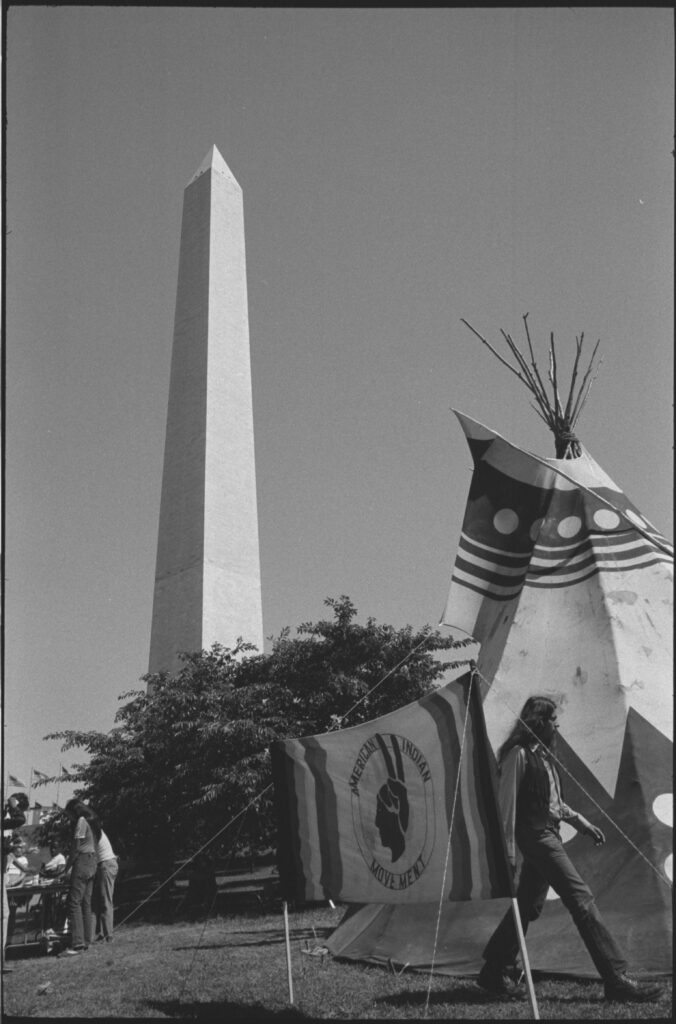
A tipi bearing an American Indian Movement sign on the Washington Monument grounds, July 11, 1978, during the Longest Walk. This encampment photograph predates the main walkers’ July 15 arrival. Credit: Warren K. Leffler / U.S. News & World Report Collection, Library of Congress. Original source. Public domain: U.S. News & World Report collection donation; no known restrictions on publication.
WASHINGTON, July 23.—The Longest Walk’s week of demonstrations has concluded after a journey that began in California five months ago. Native participants and their supporters arrived in Washington July 15 to oppose proposed legislation threatening treaty rights and to press for recognition of Native sovereignty.
The undertaking began with a February gathering at Alcatraz, followed by departure from Sacramento. People joined along the route, bringing the walkers into contact with communities whose concerns included land, fishing and mineral resources. The journey connected those local matters with the decisions being considered in Congress.
Dennis Banks and other organizers drew on experience from earlier national demonstrations. This time the claim was carried on foot, through workshops, meetings and the practical work of keeping people supplied over a long distance.
In Washington, participants gathered for marches, ceremonies and meetings. The encampment at Greenbelt and a separate spiritual vigil near the Lincoln Memorial provided places from which to bring their case before federal institutions.
The demonstrations have asked the public to examine proposals presented in the language of equal treatment that could strip away particular treaty obligations. A treaty is not made irrelevant because its enforcement inconveniences another interest. The specific terms must remain in the discussion.
The distance traveled is visible in the walk’s name. Less visible are the relationships that made it possible and the work still required after its conclusion. For those returning to California, the immediate task will be to follow the bills and decisions that brought them here, and to maintain the attention the journey has earned.
Explore the Story
Sources & further reading.
Related Herald reporting
- Congress Recognizes a Federal Duty to Protect Native Religious Practice — Katherine “Kate” Romero, 1978-08-13.
- San Diego’s Native Community Establishes an Urban Health Center — Katherine “Kate” Romero, 1979-12-09.
- A City’s Water Project Sends Kumeyaay Families Toward a New Home — Henry Pritchard, 1932-12-31.
- Court Affirms Treaty Tribes’ Share of Washington Fisheries — Katherine “Kate” Romero, 1974-02-13.
- Wounded Knee Occupation Ends After Seventy-One Days — Katherine “Kate” Romero, 1973-05-09.
- Trail of Broken Treaties Brings Twenty Demands Into Washington — Katherine “Kate” Romero, 1972-11-10.
- Alcatraz Occupation Ends; the Questions It Raised Remain on the Mainland — Thomas Navarro, 1971-06-12.
- American Indian Movement Begins With the Needs of Native City Residents — Thomas Navarro, 1968-12-22.
- Native Delegates Bring Treaties and Sovereignty to the Poor People’s Campaign — Thomas Navarro, 1968-06-20.
- Fishing Families Put Treaty Promises on the Riverbank — Thomas Navarro, 1964-03-08.
- A Younger Generation Organizes to Speak for Itself — Thomas Navarro, 1961-09-03.
- Tribal Delegates Form a National Congress to Defend Their Rights — Edward Hensley, 1944-11-19.
- Indian Child Welfare Act Sets Standards Against the Breakup of Native Families — Katherine “Kate” Romero, 1978-11-09.
Join the conversation